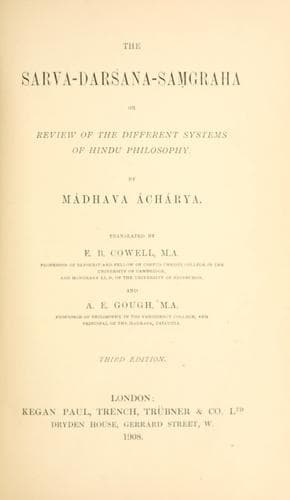
The Sarva-Darsana-Samgraha: Or, Review of the Different Systems of Hindu PhilosophyMadhava
ReligionEastern
The Sarva-Darsana-Samgraha: Or, Review of the Different Systems of Hindu Philosophy
Madhava
Philosophy, Hindu; Philosophy, Indic
doubts that arise, as they occasionally will do, in reference to this
intended meaning, which will be the proper "subject" of Mímáṃsá
discussion; and the settlement of these doubts will be its proper
"end." Therefore, whenever the true meaning of the Veda is not
obtained[260] by that reading which is virtually prescribed by the
authoritative injunction to a Brahman to teach, it will be a proper
subject for systematic discussion; and hence we hold that the study of
Mímáṃsá _is_ enjoined, and should be commenced.
"Well,[261] be it so" [say the followers of the Nyáya], "but how can
the Vedas be said to be underived from any personal author, when there
is no evidence to establish this? Would you maintain that they have no
personal author because, although there is an unbroken line of
tradition, there is no remembrance of any author, just as is the case
with the soul"?[262] This argument is weak, because the alleged
characteristics [unbroken tradition, &c.] are not proved; for those
who hold the human origin of the Vedas maintain that the line of
tradition was interrupted at the time of the dissolution of the
universe. And, again, what is meant by this assertion that the author
is not remembered? Is it (1.) that no author is believed, or (2.) that
no author is remembered? The first alternative cannot be accepted,
since we hold that God is proved to have been the author. Nor can the
second, because it cannot stand the test of the following dilemma,
viz., is it meant (_a._) that no author of the Veda is remembered by
some one person, or (_b._) by any person whatever? The former
supposition breaks down, as it would prove too much, since it would
apply to such an isolated stanza as "He who is religious and has
overcome pride and anger," &c.[263] And the latter supposition is
inadmissible, since it would be impossible for any person who was not
omniscient to know that no author of the Veda was recollected by any
person whatever. Moreover, there is actual proof that the Veda had a
personal author, for we argue as follows:--The sentences of the Veda
must have originated from a personal author, since they have the
character of sentences like those of Kálidása and other writers. And,
again, the sentences of the Veda have been composed by a competent
person, since, while they possess authority, they have, at the same
time, the character of sentences, like those of Manu and other sages.
Public-domain text, read in full here on John Shaqi.
Reviews
Reviews
No reviews yet
Be the first to share your thoughts on this work.
Elsewhere in the archive
Join the Discussion
Join the discussion
Sign in to leave a comment or review.
Sign InorCreate an account