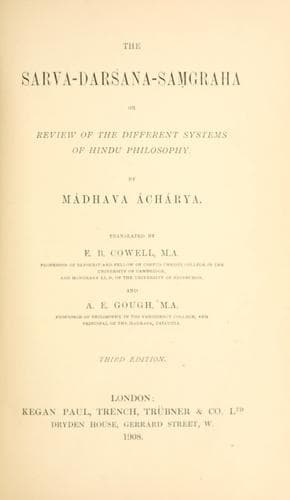
The Sarva-Darsana-Samgraha: Or, Review of the Different Systems of Hindu PhilosophyMadhava
ReligionEastern
The Sarva-Darsana-Samgraha: Or, Review of the Different Systems of Hindu Philosophy
Madhava
Philosophy, Hindu; Philosophy, Indic
But [ask the Mímáṃsakas] may it not be assumed that "all study of the
Veda was preceded by an earlier study of it by the pupil's preceptor,
since the study of the Veda must always have had one common character
which was the same in former times as now;" and therefore this
uninterrupted succession has force to prove the eternity of the Veda?
This reasoning, however [the Naiyáyikas answer], cannot rise to the
height of proof, for it has no more validity than such obviously
illusory reasoning, as "All study of the Mahábhárata was preceded by
an earlier study of it by the pupil's preceptor, since it is the study
of the Mahábhárata, which must have been the same in former times as
now." But [the Mímáṃsakas will ask whether there is not a difference
between these two cases, since] the Smṛiti declares that [Vishṇu
incarnate as] Vyása was the author of the Mahábhárata, in accordance
with the line, "Who else than the lotus-eyed Vishṇu could be the maker
of the Mahábhárata?" [while nothing of this sort is recorded in any
Smṛiti in regard to the Veda]. This argument, however, is pithless,
since those words of the Purushasúkta (Rig V., x. 90), "From him
sprang the Ṛich and Sáman verses; from him sprang the Metres; from
him the Yajus arose;" prove that the Veda had a maker.
Further [proceed the Naiyáyikas] we hold that sound is
non-eternal[264] because it has genus, and is also perceptible to the
external organs of beings such as ourselves, just as a jar is.[265]
"But," you may object, "is not this argument refuted by the proof
arising from the fact that we recognise the letter _g_ (for example)
as the same we have heard before?" This objection, however, is
extremely weak, for the recognition in question is powerless to refute
our argument, since it has reference only to identity of _species_, as
in the case of a man whose hair has been cut and has grown again, or
of a jasmine which has blossomed afresh. "But [asks the Mímáṃsaka] how
can the Veda have been uttered by the incorporeal Parameśvara, who has
no palate or other organs of speech, and therefore cannot have
pronounced the letters?" "This objection [answers the Naiyáyika] is
not happy, because, though Parameśvara is by nature incorporeal, he
can yet assume a body in sport, in order to show kindness to his
worshippers. Consequently the arguments in favour of the doctrine that
the Veda had no personal author are inconclusive."
Public-domain text, read in full here on John Shaqi.
Reviews
Reviews
No reviews yet
Be the first to share your thoughts on this work.
Elsewhere in the archive
Join the Discussion
Join the discussion
Sign in to leave a comment or review.
Sign InorCreate an account