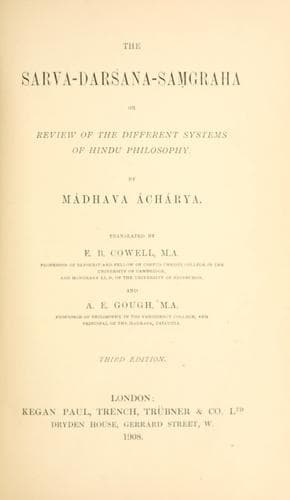
The Sarva-Darsana-Samgraha: Or, Review of the Different Systems of Hindu PhilosophyMadhava
ReligionEastern
The Sarva-Darsana-Samgraha: Or, Review of the Different Systems of Hindu Philosophy
Madhava
Philosophy, Hindu; Philosophy, Indic
I shall now [says the Mímáṃsaka] clear up the whole question. What is
meant by this _paurusheyatva_ ["derivation from a personal author"]
which it is sought to prove? Is it (1.) mere procession (_utpannatva_)
from a person, like the procession of the Veda from persons such as
ourselves, when we daily utter it? or (2.) is it the arrangement--with
a view to its manifestation--of knowledge acquired by other modes of
proof, as in the case of treatises composed by persons like ourselves?
If the first meaning be intended, there will be no dispute between
us.[266] If the second sense be meant, I ask whether it is established
(_a._) by inference,[267] or (_b._) by supernatural testimony? (_a._)
The former alternative cannot be correct, because your argument would
equally apply to the sentences in dramas such as the Málatímádhava
[which, of course, being a work of fiction, has no authoritative
character]. If you qualify your argument by inserting the saving
clause, "while they possess authority,"[268] [as supra, p. 188, line
21], even this explanation will fail to satisfy a philosopher. For the
sentences of the Veda are universally defined to be sentences which
prove things that are not provable by other evidence. But if you could
establish that these Vedic sentences only prove what is provable by
other evidence, this definition would be at once contradicted, just
as if a man were to say that his mother was a barren woman. And even
if we granted that Parameśvara might assume a body in sport, in order
to show kindness to his worshippers, it would not at all follow that
he would perceive things beyond the reach of the senses, from the want
of any means of apprehending objects removed from him in place, in
time, and in nature.[269] Nor is it to be assumed that his eyes and
other senses alone would have the power of producing such knowledge,
for we can only draw upon our imagination in accordance with our past
experience. This has been declared by the Guru [Prabhákara] when he
refutes the supposition of an omniscient author--
"Wherever we do find the power of an organ intensified,[270]
it is done without its going beyond its own proper objects;
thus it may appear in the power of seeing the very distant
or the very minute, but not in the ear's becoming cognisant
of form."
Public-domain text, read in full here on John Shaqi.
Reviews
Reviews
No reviews yet
Be the first to share your thoughts on this work.
Elsewhere in the archive
Join the Discussion
Join the discussion
Sign in to leave a comment or review.
Sign InorCreate an account