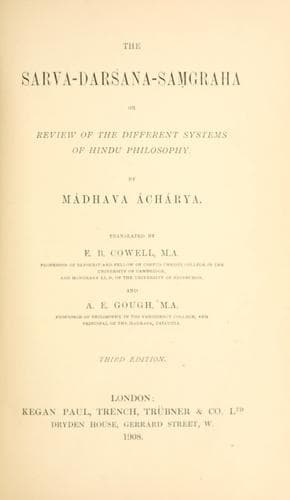
The Sarva-Darsana-Samgraha: Or, Review of the Different Systems of Hindu PhilosophyMadhava
ReligionEastern
The Sarva-Darsana-Samgraha: Or, Review of the Different Systems of Hindu Philosophy
Madhava
Philosophy, Hindu; Philosophy, Indic
Hence (_b._) we also maintain that your position cannot be established
by any supposed supernatural testimony [as that quoted above from the
Rig-Veda, "from him sprang the Ṛich and Sáman verses"]. For the
rule of Páṇini (iv. 3, 101) will still remain inviolate, that the
grammatical affixes with which such names as Káṭhaka, Kálápa, and
Taittiríya are formed, impart to those derivatives the sense of
"uttered by" Kaṭha, Kalápin, &c., though we maintain that these names
have reference [not to those parts of the Veda as first composed by
these sages, but] to the fact that these sages instituted certain
schools of traditional study. And in the same way we hold [in
reference to this verse from the Rig-Veda] that it only refers to the
institution of certain schools of traditional study of these Vedas.
Nor will any supposed inference establish the non-eternity of sound,
because [as we said before] it is opposed to the evidence of our
consciousness, [since we certainly recognise the letter now heard as
the one heard before]. Nor is it reasonable to reply that, although
the letters are not the same, they seem to be so on account of their
identity of species. For here we ask our opponents a question--Is this
idea that "the apparent sameness arises from identity of species" put
forward from a wish to preclude entirely any idea of the letters being
the same, or only [from an imagined fear of error] because experience
shows that the recognition will sometimes be erroneous [as in the
cases of the hair and jasmine mentioned above]? (_a._) If it arises
from the latter reason, we Mímáṃsakas, who hold that the Veda is its
own evidence, have said in reference to this timid imagination--
"He who foolishly imagines that something as yet unknown to
him will come hereafter to stop his present conclusion, will
go to utter ruin in every transaction of life, his mind a
mass of doubts."
Public-domain text, read in full here on John Shaqi.
Reviews
Reviews
No reviews yet
Be the first to share your thoughts on this work.
Elsewhere in the archive
Join the Discussion
Join the discussion
Sign in to leave a comment or review.
Sign InorCreate an account