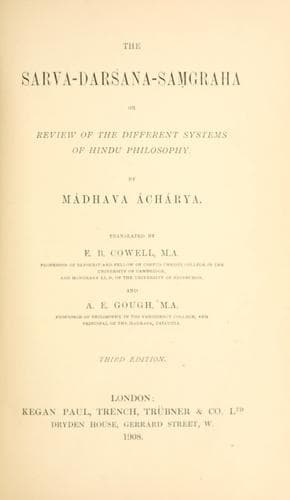
The Sarva-Darsana-Samgraha: Or, Review of the Different Systems of Hindu PhilosophyMadhava
ReligionEastern
The Sarva-Darsana-Samgraha: Or, Review of the Different Systems of Hindu Philosophy
Madhava
Philosophy, Hindu; Philosophy, Indic
These same Bauddhas discuss the highest end of man from four
standpoints. Celebrated under the designations of Mádhyamika,
Yogáchára, Sautrántika, and Vaibháshika, these Buddhists adopt
respectively the doctrines of a universal void (nihilism), an external
void (subjective idealism), the inferribility of external objects
(representationism), and the perceptibility of external objects
(presentationism).[31] Though the venerated Buddha be the only one
teacher (his disciples) are fourfold in consequence of this diversity
of views; just as when one has said, "The sun has set," the adulterer,
the thief, the divinity student, and others understand that it is time
to set about their assignations, their theft, their religious duties,
and so forth, according to their several inclinations.
It is to be borne in mind that four points of view have been laid out,
viz., (1.) All is momentary, momentary; (2.) all is pain, pain; (3.)
all is like itself alone; (4.) all is void, void.
Of these points of view, the momentariness of fleeting things, blue
and so forth (_i.e._, whatever be their quality), is to be inferred
from their existence; thus, whatever _is_ is momentary (or fluxional)
like a bank of clouds, and all these things _are_.[32] Nor may any one
object that the middle term (existence) is unestablished; for an
existence consisting of practical efficiency is established by
perception to belong to the blue and other momentary things; and the
exclusion of existence from that which is not momentary is
established, provided that we exclude from it the non-momentary
succession and simultaneity, according to the rule that exclusion of
the continent is exclusion of the contained. Now this practical
efficiency (here identified with existence) is contained under
succession and simultaneity, and no medium is possible between
succession and non-succession (or simultaneity); there being a
manifest absurdity in thinking otherwise, according to the rule--
"In a reciprocal contradiction there exists no ulterior
alternative;
"Nor is their unity in contradictories, there being a
repugnance in the very statement."[33]
And this succession and simultaneity being excluded from the permanent,
and also excluding from the permanent all practical efficiency, determine
existence of the alternative of momentariness.--Q.E.D.
Public-domain text, read in full here on John Shaqi.
Reviews
Reviews
No reviews yet
Be the first to share your thoughts on this work.
Join the Discussion
Join the discussion
Sign in to leave a comment or review.
Sign InorCreate an account