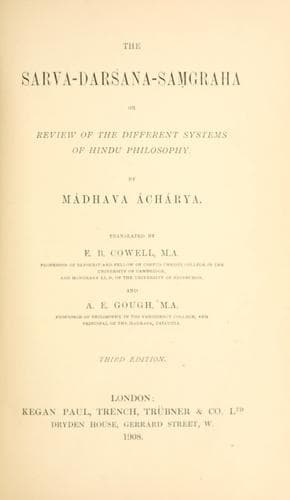
The Sarva-Darsana-Samgraha: Or, Review of the Different Systems of Hindu PhilosophyMadhava
ReligionEastern
The Sarva-Darsana-Samgraha: Or, Review of the Different Systems of Hindu Philosophy
Madhava
Philosophy, Hindu; Philosophy, Indic
2. In like manner an invariable concomitance is ascertained by the
ascertainment of identity (_e.g._, a sisu-tree is a tree, or wherever
we observe the attributes of a sisu we observe also the attribute
arboreity), an absurdity attaching to the contrary opinion, inasmuch
as if a sisu-tree should lose its arboreity it would lose its own
self. But, on the other hand, where there exists no absurdity, and
where a (mere) concomitance is again and again observed, who can
exclude all doubt of failure in the concomitance? An ascertainment of
the identity of sisu and tree is competent in virtue of the reference
to the same object (_i.e._, predication),--This tree is a sisu. For
reference to the same object (predication) is not competent where
there is no difference whatever (_e.g._, to say, "A jar is a jar," is
no combination of diverse attributes in a common subject), because the
two terms cannot, as being synonymous, be simultaneously employed; nor
can reference to the same object take place where there is a
reciprocal exclusion (of the two terms), inasmuch as we never find,
for instance, horse and cow predicated the one of the other.
It has thus been evinced that an effect or a self-same supposes a
cause or a self-same (as invariable concomitants).
If a man does not allow that inference is a form of evidence,
_pramáṇa_, one may reply: You merely assert thus much, that inference
is not a form of evidence: do you allege no proof of this, or do you
allege any? The former alternative is not allowable according to the
maxim that bare assertion is no proof of the matter asserted. Nor is
the latter alternative any better, for if while you assert that
inference is no form of evidence, you produce some truncated argument
(to prove, _i.e._, infer, that it is none), you will be involved in an
absurdity, just as if you asserted your own mother to be barren.
Besides, when you affirm that the establishment of a form of evidence
and of the corresponding fallacious evidence results from their
homogeneity, you yourself admit induction by identity. Again, when you
affirm that the dissentiency of others is known by the symbolism of
words, you yourself allow induction by causality. When you deny the
existence of any object on the ground of its not being perceived, you
yourself admit an inference of which non-perception is the middle
term. Conformably it has been said by Tathágata--
"The admission of a form of evidence in general results from
its being present to the understanding of others.
"The existence of a form of evidence also follows from its
negation by a certain person."
All this has been fully handled by great authorities; and we desist
for fear of an undue enlargement of our treatise.
Public-domain text, read in full here on John Shaqi.
Reviews
Reviews
No reviews yet
Be the first to share your thoughts on this work.
Join the Discussion
Join the discussion
Sign in to leave a comment or review.
Sign InorCreate an account