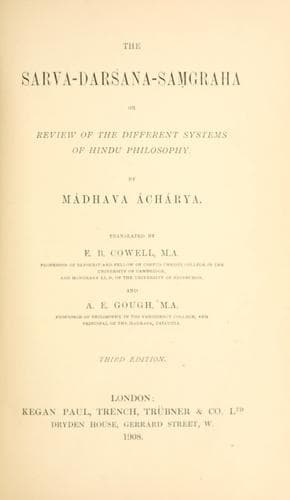
The Sarva-Darsana-Samgraha: Or, Review of the Different Systems of Hindu PhilosophyMadhava
ReligionEastern
The Sarva-Darsana-Samgraha: Or, Review of the Different Systems of Hindu Philosophy
Madhava
Philosophy, Hindu; Philosophy, Indic
This at once refutes the argument given in the [Naiyáyika] treatise
by Vágíśwara, entitled _Mána-manohara_, "sound is non-eternal from the
fact of its being a special quality belonging to an organ of
sense[273] (_sc._ the ear), just as colour is to the eye."
We can also refute it in the following ways: (_a._) If we follow the
[Sáṅkhya and Vedánta] view that sound is a substance, it is evidently
overthrown[274] [as in that case sound cannot be a quality]; (_b._) if
we take it as referring to the _noise_, not the _sound_, we have no
dispute, as it only establishes what we ourselves allow; and (_c._)
the inference is overthrown by the "limiting condition" [_upádhi_] of
_aśrávaṇatva_, or "the not causing audition."[275] So Udayana tries at
great length to establish that, although ether, the site of sound, is
imperceptible, the non-existence of that which abides in this site is
perceptible; and he then brings forward as an evidence for the
non-eternity of sound, that sense perception which causes the use of
such common expressions as "The tumult is stopped," "The sound has
arisen."[276] But he is sufficiently answered[277] by our old reply
[in p. 193], that the fallacious appearance of distinction arises
from contrary characters being erroneously ascribed, just as, in the
story, the demon Tála went away [as well as Betála] when the offering
of blood was given to the latter.[278] And as for the objection raised
by the author of the _Nyáyabhúshaṇa_,[279] that, if sound were
eternal, the conclusion must follow that it would be either always
perceptible or always imperceptible, this also is obviated by our
allowing that we only perceive that sound which is manifested by our
articulate noise.[280] And as for the (Naiyáyika) argument against the
existence[281] of such a constant relation as this which is supposed
between the manifested "sound" and the manifesting "noise," since they
both come simultaneously in contact with the sense of hearing, this is
invalid, as it will indisputably apply with equal force in the case of
the soul.[282]
Therefore as the Veda is thus proved to have not originated from any
personal author, and as the minutest germ of suspicion against it is
thus absolutely destroyed, we hold it as satisfactorily demonstrated
that it has a self-established authority in all matters relating to
duty.
"Well"[283] [say our opponents], "let this question rest; but how
about another well-known controversy? It is said--
Public-domain text, read in full here on John Shaqi.
Reviews
Reviews
No reviews yet
Be the first to share your thoughts on this work.
Elsewhere in the archive
Join the Discussion
Join the discussion
Sign in to leave a comment or review.
Sign InorCreate an account