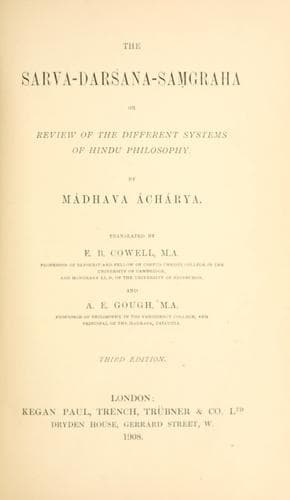
The Sarva-Darsana-Samgraha: Or, Review of the Different Systems of Hindu PhilosophyMadhava
ReligionEastern
The Sarva-Darsana-Samgraha: Or, Review of the Different Systems of Hindu Philosophy
Madhava
Philosophy, Hindu; Philosophy, Indic
"'The Sáṅkhyas hold that both authoritativeness and non-authoritativeness
are self-proved; the followers of the Nyáya hold that both are proved by
something else [as inference, &c.]; the Buddhists hold that the latter is
self-proved and the former proved by something else; the teachers of the
Veda maintain that authoritativeness is self-proved and
non-authoritativeness proved by something else.' Now we ask, amidst all
this discussion, how do the Mímáṃsakas accept as established their tenet
that the authoritativeness of duty is self-proved? And what is the meaning
of this so-called self-proved authoritativeness? Is it (_a._) that
authoritativeness springs from itself? or (_b._) that it springs from the
right knowledge in which it resides? or (_c._) that it springs from the
instrumental causes [as the eye, &c.] which produced the right knowledge
in which it resides? or (_d._) that it resides in a particular knowledge
produced by the instrumental causes which produced the right
knowledge?[284] or (_e._) that it resides in a particular knowledge
produced by the instrumental causes _only_ which produced the right
knowledge?
"(_a._) It cannot be the _first_, because wherever the relation of
cause and effect is found there must be a difference, and therefore
these two cannot reside in the same subject [_i.e._, authoritativeness
cannot cause itself]. (_b._) It cannot be the _second_, because if
knowledge, which is a quality, were the cause of authoritativeness, it
would have to be a substance, as being an intimate cause.[285] (_c._)
It cannot be the _third_, because 'authoritativeness' cannot properly
be 'produced' at all,[286] whether we call it a general
characteristic (_upádhi_) or a species (_játi_);[287] for if we call
it an _upádhi_, it is defined as the absolute non-existence of any
contradiction to a certain kind of knowledge which does not possess
the nature of recollection;[288] and this cannot be produced, for we
all allow that absolute non-existence is eternal; and still less can
we speak of its being produced, if we regard it as a species. (_d._)
Nor can it be the _fourth_, for wrong knowledge [as well as right
knowledge] is a particular kind of knowledge, and the instrumental
causes which produce the general are included in those which produce
the particular,[289] just as the general idea 'seed,' as applied to
'tree,' is included in the particular seed of any special tree, as,
_e.g._, the Dalbergia Sisu; otherwise we might suppose that the
particular had no instrumental cause at all. Your definition would
therefore extend too far [and include erroneous as well as true
knowledge]; for non-authoritativeness, which Vedantists and most
Mímáṃsakas allow to be produced by something external, must also be
considered as residing in a particular knowledge [_i.e._, a wrong
knowledge] produced [in part] by the instrumental causes which
produced the right knowledge. (_e._) As for your _fifth_ view, we ask
Public-domain text, read in full here on John Shaqi.
Reviews
Reviews
No reviews yet
Be the first to share your thoughts on this work.
Elsewhere in the archive
Join the Discussion
Join the discussion
Sign in to leave a comment or review.
Sign InorCreate an account