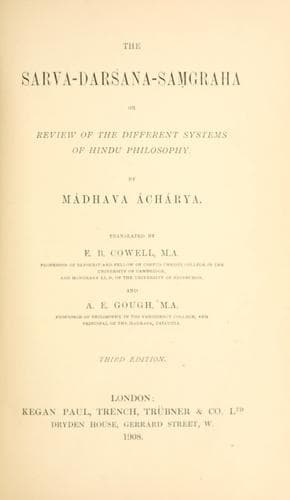
The Sarva-Darsana-Samgraha: Or, Review of the Different Systems of Hindu PhilosophyMadhava
ReligionEastern
The Sarva-Darsana-Samgraha: Or, Review of the Different Systems of Hindu Philosophy
Madhava
Philosophy, Hindu; Philosophy, Indic
whether by being produced by the instrumental causes _only_ which
produced right knowledge, you mean to include or exclude the absence
of a 'defect'? It cannot be the former alternative; because the
followers of the Nyáya who hold that authoritativeness is proved by
something external [as inference, &c.], would at once grant that
authoritativeness is produced by the instrumental causes of knowledge
combined with the absence of a 'defect.' Neither can it be the latter
alternative; for, inasmuch as it is certain that the absence of a
'defect' is found combined with the various instrumental causes, this
absence of a 'defect' is fixed as by adamantine glue to be a cause of
right knowledge, since right knowledge will always accompany its
presence, and be absent if it is absent,[290] and it will at the same
time be not an unimportant condition.[291] If you object that
non-existence (or absence) cannot be a cause, we reply by asking you
whether non-existence can be an effect or not? If it cannot, then we
should have to allow that cloth is eternal, as its "emergent
non-existence" or destruction would be impossible. If it can be an
effect, then why should it not be a cause also? So this rope binds you
at both ends. This has also been said by Udayana [in his Kusumáñjali,
i. 10]--
"'As existence, so too non-existence is held to be a cause
as well as an effect.'
"The argument, in my opinion, runs as follows:--Right knowledge
depends on some cause[292] other than the common causes of knowledge,
from the very fact that, while it is an effect, it is also knowledge,
just as wrong knowledge does.[293] Authoritativeness is known through
something external to itself [_e.g._, inference], because doubt arises
in regard to it in an unfamiliar case, as we also see in
non-authoritativeness.
"Therefore, as we can prove that authoritativeness is both produced
and recognised by means of something external, the Mímáṃsá tenet that
'authoritativeness is self-proved' is like a gourd overripe and
rotten."
Public-domain text, read in full here on John Shaqi.
Reviews
Reviews
No reviews yet
Be the first to share your thoughts on this work.
Elsewhere in the archive
Join the Discussion
Join the discussion
Sign in to leave a comment or review.
Sign InorCreate an account