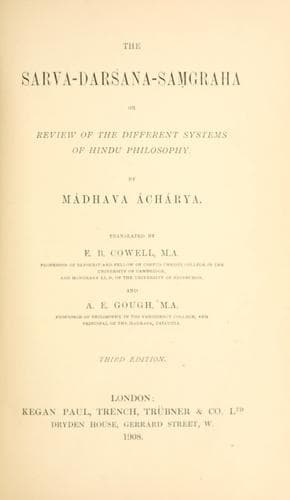
The Sarva-Darsana-Samgraha: Or, Review of the Different Systems of Hindu PhilosophyMadhava
ReligionEastern
The Sarva-Darsana-Samgraha: Or, Review of the Different Systems of Hindu Philosophy
Madhava
Philosophy, Hindu; Philosophy, Indic
This long harangue of our opponent, however, is but a vain attempt to
strike the sky with his fist; for (_a._) we mean by our phrase
"self-proved" that while right knowledge is produced by the
instrumental causes of knowledge, it is not produced by any other
cause (as "defect," &c.) The following is our argument as drawn out in
full:--Right knowledge is not produced by any other instrumental
causes than those of knowledge, while, at the same time, it is
produced by these, because it is not the site of wrongness of
knowledge,--just like a jar.[294] Nor can Udayana's[295] argument be
brought forward as establishing the dependence of authoritativeness on
something external, for it is swallowed up by the dragon of the
equally potent contradictory argument. "Right knowledge is not
produced by any cause which is other than the causes of knowledge and
is also other than 'defect,'[296] from the very fact of its being
knowledge--like wrong knowledge." Again, since right knowledge can
arise from the causes of knowledge _per se_, it would be a needless
complexity to suppose that anything else is a cause, whether you call
it a _guṇa_ or the absence of a "defect" (_dosha_).[297]
"But surely if the presence of a defect is the cause of wrong
knowledge, it is difficult to deny that its absence must be a cause of
right knowledge?" We meet this, however, by maintaining that the
absence of defect is only an indirect and remote cause, as it only
acts negatively by preventing wrong knowledge. As it has been said--
"Therefore we reasonably conclude from the presence of
_guṇas_ the absence of 'defects,'[298] from their absence
the non-existence of the two kinds of
non-authoritativeness,[299] and from this the general
conclusion."[300]
(_b._) We maintain that the recognition of right knowledge is produced
by the same causes only which make us perceive the first
knowledge[301] [_sc._ the eye, mind, &c.] Nor can you object that this
view is precluded, because it would imply that there could be no such
thing as doubt; for we answer that doubt arises in cases where,
although all the causes which produce knowledge are present, there is
also the simultaneous presence of some opposing cause, as a "defect,"
&c.
As for your argument [O Naiyáyika! given _supra_, in p. 198, lines
17-24], I ask, Is your own argument an authoritative proof by itself
or not? If it is, it proves too much [for it would properly apply to
itself and lead us to infer its own dependence on external proof,
whereas you hold it to be independent of such]; and if it is not, we
should have a case of _regressus in infinitum_, for it will want some
other proof to confirm its authoritativeness, and this too in its turn
will want some fresh proof, and so on for ever.
Public-domain text, read in full here on John Shaqi.
Reviews
Reviews
No reviews yet
Be the first to share your thoughts on this work.
Elsewhere in the archive
Join the Discussion
Join the discussion
Sign in to leave a comment or review.
Sign InorCreate an account