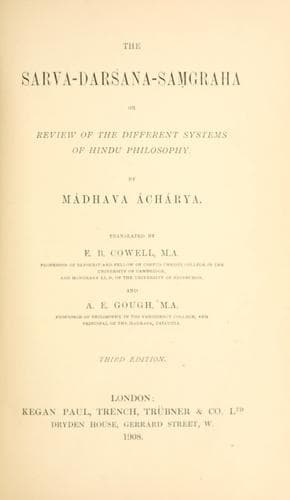
The Sarva-Darsana-Samgraha: Or, Review of the Different Systems of Hindu PhilosophyMadhava
ReligionEastern
The Sarva-Darsana-Samgraha: Or, Review of the Different Systems of Hindu Philosophy
Madhava
Philosophy, Hindu; Philosophy, Indic
As for the argument urged by Udayana[302] in the Kusumáñjali, when he
tries to establish that immediate and vehement action does not depend
on the agent's certainty as to the authoritativeness of the speech
which sets him acting: "Action depends on wish, its vehemence on that
of the wish,[303] wish on the knowledge that the thing wished for is
a means to attain some wished-for end, and this is only ascertained by
an inference based on some 'sign' which proves that the thing is
closely connected with the wished-for end, and this inference depends
on the things being in direct contact with the agent's senses; but
throughout the whole series of antecedent steps the Mímáṃsá idea of
the perception of authoritativeness is never once found as a cause of
action." All this appears to us simple bluster, like that of the thief
who ostentatiously throws open all his limbs before me, when I had
actually found the gold under his armpit. It is only the knowledge
that the thing is a means to attain the desired end, and this
knowledge recognised as authoritative and right knowledge, which
causes the definite volition to arise at all; and in this we can
distinctly trace the influence of that very perception of
authoritativeness [whose existence he so vehemently pretended to
deny]. If unhesitating action ever arose in any case from doubt, then,
as it might always arise so in every given case, all ascertainment of
authoritativeness would be useless; and as the very existence of what
is unascertained is rendered uncertain, poor authoritativeness would
have to be considered as dead and buried! But enough of this prolix
controversy; since it has been said--
"Therefore the authoritativeness of a cognition, which
(authoritativeness) presented itself as representing a real
fact, may be overthrown by the perception of a 'defect,'
which perception is produced by some sign that proves the
discrepancy between the cognition and the fact."[304]
Now with regard to the Veda, which is the self-proved and
authoritative criterion in regard to duty, [we have the following
divergency between the two great Mímáṃsá schools]:--The Veda is
composed of three portions, respectively called "hymns" (_mantra_),
"explanatory passages" (_arthaváda_), and "injunctions" (_vidhi_); and
by "injunction" we mean such sentences as "Let him who desires heaven
sacrifice with the jyotishṭoma." Here _ta_, the affix of the third
person singular, denotes an enjoining power, which is "coloured" [or
rendered definite] by the meaning of the root, according to the
opinion of the followers of Bhaṭṭa Kumárila, who maintain that words
signify[305] something definite by themselves [apart from the
sentence]. The followers of Guru Prabhákara, on the contrary, hold
that the whole sentence is a command relating to the sacrifice, as
they maintain that words only signify an action or something to be
done.[306] Thus all has been made plain.
E. B. C.
FOOTNOTES:
Public-domain text, read in full here on John Shaqi.
Reviews
Reviews
No reviews yet
Be the first to share your thoughts on this work.
Elsewhere in the archive
Join the Discussion
Join the discussion
Sign in to leave a comment or review.
Sign InorCreate an account