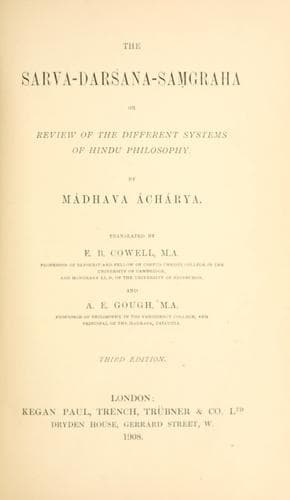
The Sarva-Darsana-Samgraha: Or, Review of the Different Systems of Hindu PhilosophyMadhava
ReligionEastern
The Sarva-Darsana-Samgraha: Or, Review of the Different Systems of Hindu Philosophy
Madhava
Philosophy, Hindu; Philosophy, Indic
[Footnote 247: Mádhava here calls it the _práchí Mímáṃsá_.]
[Footnote 248: Cf. _J. Nyáyamálávist_, pp. 5-9.]
[Footnote 249: Thus it is said that he who desires to be a family
priest should offer a black-necked animal to Agni, a parti-coloured
one to Soma, and a black-necked one to Agni. Should this be a case for
_tantra_ or not? By _tantra_ one offering to Agni would do for both;
but as the offering to Soma comes between, they cannot be united, and
thus it must be a case of _ávápa_, _i.e._, offering the two separately
(_J. Nyáyamálá_, xi. 1, 13).]
[Footnote 250: In p. 123, line 4, I read _vilakshaṇa-dṛishṭaphala_.]
[Footnote 251: In the former case it would be a _vidhi_, in the latter
a _niyama_. Cf. the lines _vidhir atyantam aprápto niyamaḥ pákshike
sati, tatra chányatra cha práptau parisaṃkhyá vidhíyate_.]
[Footnote 252: The Mímáṃsá holds that the potential and similar
affixes, which constitute a _vidhi_, have a twofold power; by the one
they express an active volition of the agent, corresponding to the
root-meaning (_artha-bhávaná_); by the other an enforcing power in the
word (_śabda-bhávaná_). Thus in _svargakámo yajeta_, the _eta_ implies
"let him produce heaven by means of certain acts which together make
up a sacrifice possessing a certain mystic influence;" next it implies
an enforcing power residing in itself (as it is the word of the
self-existent Veda and not of God) which sets the hearer upon this
course of action.]
[Footnote 253: These four "fruits of action" are obscure, and I do not
remember to have seen them alluded to elsewhere. I was told in India
that they were a thing's coming into being, growing, declining, and
perishing. If so, they are the second, third, fifth, and sixth of the
six _vikáras_ mentioned in Śaṅkara's Vajrasúchi, 2, _i.e._, _asti_,
_jáyate_, _vardhate_, _vipariṇamate_, _apakshíyate_, _naśyati_. I do
not see how there could be any reference to the four kinds of
_apúrva_, sc. _phala_, _samudáya_, _utpatti_, and _aṅga_, described in
Nyáya M. V. ii. 1, 2.]
[Footnote 254: The _nigamas_ are the Vedic quotations in Yáska's
_nirukta_.]
[Footnote 255: See Nyáya-málá-vistara, i. 4, 19.]
[Footnote 256: The exact number is 915.]
[Footnote 257: This is to explain the last of the five members, the
_saṃgati_.]
[Footnote 258: Cf. Aśvaláyana's Gṛihya Sútras, i. 19, 1.]
[Footnote 259: The _anuváda_, of course, implies a previous _vidhi_,
which it thus repeats and supplements, and so carries with it an equal
authority. The _anuváda_ in the present case is the passage which
mentions that the Veda is to be read, as it enforces the previous
_vidhi_ as to teaching.]
[Footnote 260: I read in p. 127, line 12, _anava-gamyamánasya_, and so
the recension given in the Nyáya M. V. p. 14, _na budhyamánasya_.]
[Footnote 261: In the next two or three pages I have frequently
borrowed from Dr. Muir's translation in his _Sanskrit Texts_, vol.
iii. p. 88.]
Public-domain text, read in full here on John Shaqi.
Reviews
Reviews
No reviews yet
Be the first to share your thoughts on this work.
Elsewhere in the archive
Join the Discussion
Join the discussion
Sign in to leave a comment or review.
Sign InorCreate an account