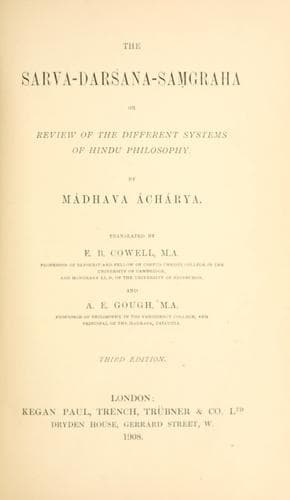
The Sarva-Darsana-Samgraha: Or, Review of the Different Systems of Hindu PhilosophyMadhava
ReligionEastern
The Sarva-Darsana-Samgraha: Or, Review of the Different Systems of Hindu Philosophy
Madhava
Philosophy, Hindu; Philosophy, Indic
[Footnote 262: The soul may be traced back through successive
transmigrations, but you never get back to its beginning.]
[Footnote 263: Mádhava means that the author of this stanza, though
unknown to many people, was not necessarily unknown to all, as his
contemporaries, no doubt, knew who wrote it, and his descendants might
perhaps still be aware of the fact. In this case, therefore, we have
an instance of a composition of which some persons did not know the
origin, but which, nevertheless, had a human author. The stanza in
question is quoted in full in Böhtlingk's Indische Sprüche, No. 5598,
from the MS. anthology called the _Subháshitárṇava_. For _muktaka_,
see _Sáh. Darp._, § 558.]
[Footnote 264: The eternity of the Veda depends on this tenet of the
Mímáṃsá that sound is eternal.]
[Footnote 265: Eternal things (as the atoms of earth, fire, water, and
air, minds, time, space, ether, and soul) have _viśesha_, not
_sámánya_ or genus, and they are all imperceptible to the senses.
Genera are themselves eternal (though the individuals in which they
reside are not), but they have not themselves genus. Both these
arguments belong rather to the Nyáya-vaiśeshika school than to the
Nyáya.]
[Footnote 266: The Mímáṃsaka allows that the _uchcháraṇa_ or utterance
is non-eternal.]
[Footnote 267: The inference will be as follows: "The Vedas were
arranged after being acquired by other modes of proof, with a view to
their manifestation, from the very fact of their having the nature of
sentences, just like the compositions of Manu, &c."]
[Footnote 268: The argument will now run, "The Vedas were arranged
after being acquired by other modes of proof, because, while they
possess authority, they still have the nature of sentences, like the
composition of Manu, &c."]
[Footnote 269: In assuming a material body, he would be subject to
material limitations.]
[Footnote 270: The Jainas allow thirty-four such superhuman
developments (_atiśayáḥ_) in their saints.]
[Footnote 271: Jaimini maintains that the vibrations of the air
"manifest" the always existing sound.]
[Footnote 272: "What is meant by 'noise' (_náda_) is these
'conjunctions' and 'disjunctions,' occasioned by the vibrations of the
air."--_Ballantyne_, _Mímáṃsá Aphorisms_, i. 17.]
[Footnote 273: The Nyáya holds that colour and sound are respectively
special qualities of the elements light and ether; and as the organs
of seeing and hearing are composed of light and ether, each will, of
course, have its corresponding special quality.]
[Footnote 274: In p. 131, line 7, I read _pratyakshásiddheḥ_.]
Public-domain text, read in full here on John Shaqi.
Reviews
Reviews
No reviews yet
Be the first to share your thoughts on this work.
Elsewhere in the archive
Join the Discussion
Join the discussion
Sign in to leave a comment or review.
Sign InorCreate an account