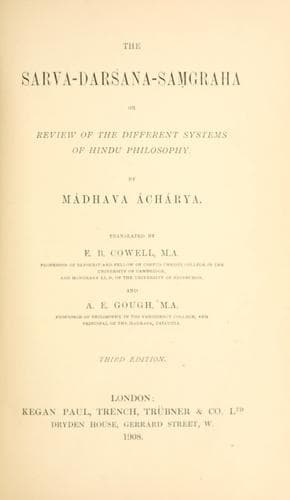
The Sarva-Darsana-Samgraha: Or, Review of the Different Systems of Hindu PhilosophyMadhava
ReligionEastern
The Sarva-Darsana-Samgraha: Or, Review of the Different Systems of Hindu Philosophy
Madhava
Philosophy, Hindu; Philosophy, Indic
[Footnote 275: Cf. my note pp. 7, 8, (on the Chárváka-darśana) for the
_upádhi_. The _upádhi_ or "condition" limits a too general middle
term; it is defined as "that which always accompanies the major term,
but does not always accompany the middle." Thus if the condition
"produced from wet fuel" is added to "fire," the argument "the
mountain has smoke because it has fire" is no longer a false one.
Here, in answer to the Nyáya argument in the text, our author objects
that its middle term ("from the fact of its being a special quality
belonging to an organ of sense") is too wide, _i.e._, it is sometimes
found where the major term "non-eternal" is not found, as, _e.g._, in
_sound_ itself, according to the Mímáṃsá doctrine. To obviate this he
proposes to add the "condition," "not causing audition," as he will
readily concede that all those things are non-eternal which, _while
not causing audition_, are special qualities belonging to an organ of
sense, as, _e.g._, colour. But I need scarcely add that this addition
would make the whole argument nugatory. In fact, the Púrva Mímáṃsá and
the Nyáya can never argue together on this question of the eternity of
sound, as their points of view are so totally different.]
[Footnote 276: In the former case we have the _dhwaṃsa_ of sound, in
the latter its _prágabháva_.]
[Footnote 277: In p. 131, line 12, I read _samapauhi_ for _samápohi_,
_i.e._, the passive aorist of _sam_ + _apa_ + _úh_.]
[Footnote 278: I do not know this legend. Tála and Betála are the two
demons who carry Vikramáditya on their shoulders in the
Siṃhásan-battísí. It appears to be referred to here as illustrating
how one answer can suffice for two opponents.]
[Footnote 279: This is probably a work by Bhásarvajña (see Dr. Hall's
_Bibl. Index_, p. 26).]
[Footnote 280: _Dhvani_, or our "articulate noise," produces the
vibrations of air which render manifest the ever-existing sound. There
is always an eternal but inaudible hum going on, which we modify into
a definite speech by our various articulations. I take _saṃskṛita_
here as equivalent to _abhivyakta_.]
[Footnote 281: I read in p. 131, line 15,
_saṃskárakasaṃskáryabhávábhávánumánam_.]
[Footnote 282: It would be a case of _vyabhichára_. The Naiyáyika
argument would seem to be something as follows:--Sound is not thus
manifested by noise, since both are simultaneously perceived by the
senses, just as we see in the parallel case of the individual and its
species; these are both perceived together, but the individual is not
manifested by the species. But the Mímáṃsá rejoins that this would
equally apply to the soul and knowledge; as the internal sense
perceives both simultaneously, and therefore knowledge ought not to be
manifested by the soul, which is contrary to experience. But I am not
sure that I rightly understand the argument.]
[Footnote 283: Here begins a long _púrva-paksha_, from p. 131, line
18, down to p. 133, line 9; see p. 198 _infra_.]
Public-domain text, read in full here on John Shaqi.
Reviews
Reviews
No reviews yet
Be the first to share your thoughts on this work.
Elsewhere in the archive
Join the Discussion
Join the discussion
Sign in to leave a comment or review.
Sign InorCreate an account