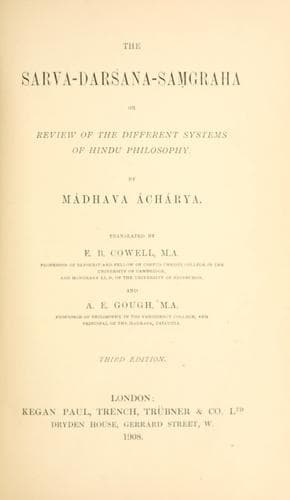
The Sarva-Darsana-Samgraha: Or, Review of the Different Systems of Hindu PhilosophyMadhava
ReligionEastern
The Sarva-Darsana-Samgraha: Or, Review of the Different Systems of Hindu Philosophy
Madhava
Philosophy, Hindu; Philosophy, Indic
understanding of words, since their number is infinite, as divided
into proper and improper words.[317] Thus there is a tradition that
Bṛihaspati for a thousand divine years taught to Indra the study of
words as used in their individual forms when the Veda is read word by
word,[318] and still he came not to the end. Here the teacher was
Bṛihaspati, the pupil was Indra, and the time of study a thousand
years of the gods; and yet the termination was not reached,--how much
less, then, in our day, let a man live ever so long? Learning is
rendered efficient by four appropriate means,--reading, understanding,
practising, and handing it on to others; but in the proposed way life
would only suffice for the bare time of reading; therefore the reading
word by word is not a means for the knowledge of words, and
consequently, as we said at first, the desired end is not
established." We reply, however, that it was never conceded that the
knowledge of words was to be attained by this reading word by word.
And again, since general and special rules apply at once to many
examples, when these are divided into the artificial parts called
roots, &c. (just as one cloud rains over many spots of ground), in
this way we can easily comprehend an exposition of many words. Thus,
for instance, by the general rule (iii. 2, 1), _karmaṇi_, the affix
_aṇ_ is enjoined after a root when the object is in composition with
it; and by this rule we learn many words, as _kumbhakára_, "a potter,"
_káṇḍaláva_, "a cutter of stems," &c. But the supplementary special
rule (iii. 2, 3), _áto 'nupasarge kaḥ_, directing that the affix _ka_
is to be used after a root that ends in long _á_ when there is no
_upasarga_, shows how impracticable this reading word by word would be
[since it would never teach us how to distinguish an _upasarga_]. "But
since there are other _aṅgas_, why do you single out grammar as the
one object of honour?" We reply, that among the six _aṅgas_ the
principal one is grammar, and labour devoted to what is the principal
is sure to bear fruit. Thus it has been said--
"Nigh unto Brahman himself, the highest of all religious
austerities,
"The wise have called grammar the first _aṅga_ of the Veda."
Hence we conclude that the exposition of words is the direct end of
the rules of grammar, but its indirect end is the preservation, &c.,
of the Veda. Hence it has been said by the worshipful author of the
great Commentary [quoting a Várttika], "the end (or motive) is
preservation, inference, scripture, facility, and assurance."[319]
Moreover prosperity arises from the employment of a correct word; thus
Kátyáyana has said, "There is prosperity in the employment of a word
according to the _śástra_; it is equal to the words of the Veda
itself." Others also have said that "a single word thoroughly
understood and rightly used becomes in Swarga the desire-milking cow."
Thus (they say)--
Public-domain text, read in full here on John Shaqi.
Reviews
Reviews
No reviews yet
Be the first to share your thoughts on this work.
Elsewhere in the archive
Join the Discussion
Join the discussion
Sign in to leave a comment or review.
Sign InorCreate an account