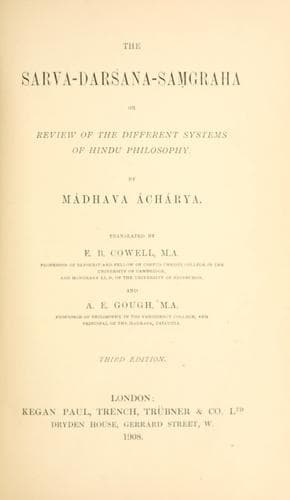
The Sarva-Darsana-Samgraha: Or, Review of the Different Systems of Hindu PhilosophyMadhava
ReligionEastern
The Sarva-Darsana-Samgraha: Or, Review of the Different Systems of Hindu Philosophy
Madhava
Philosophy, Hindu; Philosophy, Indic
"They proceed to heaven, with every desired happiness, in
well-yoked chariots of harnessed speech;
"But those who use such false forms as _achíkramata_ must
trudge thither on foot."[320]
Nor need you ask "how can an irrational word possess such power?"
since we have revelation declaring that it is like to the great god.
For the Śruti says, "Four are its horns, three its feet, two its
heads, and seven its hands,--roars loudly the threefold-bound bull,
the great god enters mortals" (Rig-Veda, iv. 58, 3). The great
commentator thus explains it:--The "four horns" are the four kinds of
words--nouns, verbs, prepositions, and particles; its "three feet"
mean the three times, past, present, and future, expressed by the
tense-affixes, _laṭ_, &c.; the "two heads," the eternal and temporary
(or produced) words, distinguished as the "manifested" and the
"manifester;" its "seven hands" are the seven case affixes, including
the conjugational terminations; "threefold bound," as enclosed in the
three organs--the chest, the throat, and the head. The metaphor "bull"
(_vṛishabha_) is applied from its pouring forth (_varshaṇa_), _i.e._,
from its giving fruit when used with knowledge. "Loudly roars,"
_i.e._, utters sound, for the root _ru_ means "sound;" here by the
word "sound" developed speech (or language)[321] is implied; "the
great god enters mortals,"--the "great god," _i.e._, speech,--enters
mortals, _i.e._, men endowed with the attribute of mortality. Thus is
declared the likeness [of speech][322] to the supreme Brahman.
The eternal word, called _sphoṭa_, without parts, and the cause of the
world, is verily Brahman; thus it has been declared by Bhartṛihari in
the part of his book called the Brahmakáṇḍa--
"Brahman, without beginning or end, the indestructible
essence of speech,
"Which is developed in the form of things, and whence
springs the creation of the world."
"But since there is a well-known twofold division of words into nouns
and verbs, how comes this fourfold division?" We reply, because this,
too, is well known. Thus it has been said in the Prakírṇaka--
"Some make a twofold division of words, some a fourfold or a
fivefold,
"Drawing them up from the sentences as root, affix, and the
like."
Helárája interprets the fivefold division as including
_karmapravachaníyas_.[323] But the fourfold division, mentioned by the
great commentator, is proper, since _karmapravachaníyas_ distinguish a
connection produced by a particular kind of verb, and thus, as marking
out a particular kind of connection and so marking out a particular
kind of verb, they are really included in compounded prepositions
(_upasargas_).[324]
Public-domain text, read in full here on John Shaqi.
Reviews
Reviews
No reviews yet
Be the first to share your thoughts on this work.
Elsewhere in the archive
Join the Discussion
Join the discussion
Sign in to leave a comment or review.
Sign InorCreate an account