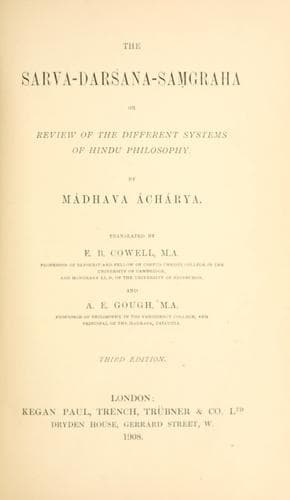
The Sarva-Darsana-Samgraha: Or, Review of the Different Systems of Hindu PhilosophyMadhava
ReligionEastern
The Sarva-Darsana-Samgraha: Or, Review of the Different Systems of Hindu Philosophy
Madhava
Philosophy, Hindu; Philosophy, Indic
"But," say some, "why do you talk so much of an eternal sound called
_sphoṭa_? This we do not concede, since there is no proof that there
is such a thing." We reply that our own perception is the proof. Thus
there is one word "cow," since all men have the cognition of a word
distinct from the various letters composing it. You cannot say, in the
absence of any manifest contradiction, that this perception of the
word is a false perception.
Hence you must concede that there is such a thing as _sphoṭa_, as
otherwise you cannot account for the cognition of the meaning of the
word. For the answer that its cognition arises from the letters cannot
bear examination, since it breaks down before either horn of the
following dilemma:--Are the letters supposed to produce this cognition
of the meaning in their united or their individual capacity? Not the
first, for the letters singly exist only for a moment, and therefore
cannot form a united whole at all; and not the second, since the
single letters have no power to produce the cognition of the meaning
[which the word is to convey]. There is no conceivable alternative
other than their single or united capacity; and therefore it follows
(say the wise in these matters) that, as the letters cannot cause the
cognition of the meaning, there must be a _sphoṭa_ by means of which
arises the knowledge of the meaning; and this _sphoṭa_ is an eternal
sound, distinct from the letters and revealed by them, which causes
the cognition of the meaning. "It is disclosed (_sphuṭyate_) or
revealed by the letters," hence it is called _sphoṭa_, as revealed by
the letters; or "from it is disclosed the meaning," hence it is called
_sphoṭa_ as causing the knowledge of the meaning,--these are the two
etymologies to explain the meaning of the word. And thus it hath been
said by the worshipful Patañjali in the great Commentary, "Now what is
the word '_cow_' _gauḥ_? It is that word by which, when pronounced,
there is produced the simultaneous cognition of dewlap, tail, hump,
hoofs, and horns." This is expounded by Kaiyaṭa in the passage
commencing, "Grammarians maintain that it is the word, as distinct
from the letters, which expresses the meaning, since, if the letters
expressed it, there would be no use in pronouncing the second and
following ones [as the first would have already conveyed all we
wished]," and ending, "The _Vákyapadíya_ has established at length
that it is the _sphoṭa_ which, distinct from the letters and revealed
by the sound, expresses the meaning."[325]
Public-domain text, read in full here on John Shaqi.
Reviews
Reviews
No reviews yet
Be the first to share your thoughts on this work.
Elsewhere in the archive
Join the Discussion
Join the discussion
Sign in to leave a comment or review.
Sign InorCreate an account