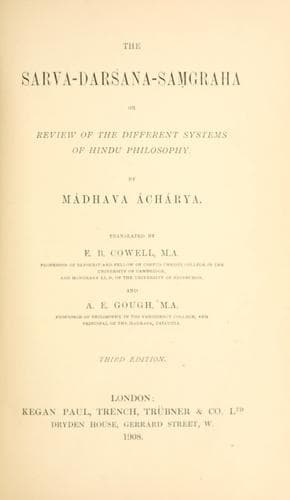
The Sarva-Darsana-Samgraha: Or, Review of the Different Systems of Hindu PhilosophyMadhava
ReligionEastern
The Sarva-Darsana-Samgraha: Or, Review of the Different Systems of Hindu Philosophy
Madhava
Philosophy, Hindu; Philosophy, Indic
Here, however, an objector may urge, "But should we not rather say
that the _sphoṭa_ has no power to convey the meaning, as it fails
under either of the following alternatives, for is it supposed to
convey the meaning when itself manifested or unmanifested? Not the
latter, because it would then follow that we should find the effect of
conveying the meaning always produced, since, as _sphoṭa_ is supposed
to be eternal, and there would thus be an ever-present cause
independent of all subsidiary aids, the effect could not possibly fail
to appear. Therefore, to avoid this fault, we must allow the other
alternative, viz., that _sphoṭa_ conveys the meaning when it is itself
manifested. Well, then, do the manifesting letters exercise this
manifesting power separately or combined? Whichever alternative you
adopt, the very same faults which you alleged against the hypothesis
of the letters expressing the meaning, will have to be met in your
hypothesis that they have this power to manifest _sphoṭa_." This has
been said by Bhaṭṭa in his Mímáṃsá-śloka-várttika--
"The grammarian who holds that _sphoṭa_ is manifested by the
letters as they are severally apprehended, though itself one
and indivisible, does not thereby escape from a single
difficulty."
The truth is, that, as Páṇini (i. 4, 14) and Gotama (Sút. ii. 123) both
lay it down that letters only then form a word when they have an affix at
the end, it is the letters which convey the word's meaning through the
apprehension of the conventional association of ideas which they
help.[326] If you object that as there are the same letters in _rasa_ as
in _sara_, in _nava_ as in _vana_, in _díná_ as in _nadí_, in _mára_ as in
_ráma_, in _rája_ as in _jára_, &c., these several pairs of words would
not convey a different meaning, we reply that the difference in the order
of the letters will produce a difference in the meaning. This has been
said by Tautátita--
"As are the letters in number and kind, whose power is
perceived in conveying any given meaning of a word, so will
be the meaning which they convey."
Therefore, as there is a well-known rule that when the same fault
attaches to both sides of an argument it cannot be urged against one
alone, we maintain that the hypothesis of the existence of a separate
thing called _sphoṭa_ is unnecessary, as we have proved that it is the
letters which express the word's meaning [your arguments against our
view having been shown to be irrelevant].
Public-domain text, read in full here on John Shaqi.
Reviews
Reviews
No reviews yet
Be the first to share your thoughts on this work.
Elsewhere in the archive
Join the Discussion
Join the discussion
Sign in to leave a comment or review.
Sign InorCreate an account