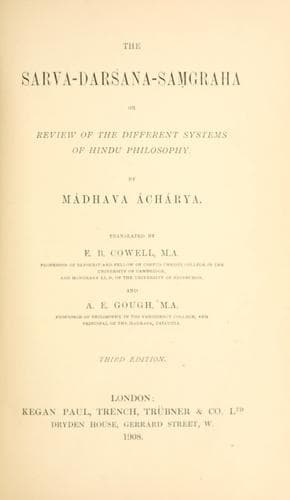
The Sarva-Darsana-Samgraha: Or, Review of the Different Systems of Hindu PhilosophyMadhava
ReligionEastern
The Sarva-Darsana-Samgraha: Or, Review of the Different Systems of Hindu Philosophy
Madhava
Philosophy, Hindu; Philosophy, Indic
All this long oration is really only like a drowning man's catching at
a straw;[327] for either of the alternatives is impossible, whether
you hold that it is the single letters or their aggregation which
conveys the meaning of the word. It cannot be the former, because a
collection of separate letters, without any one pervading cause,[328]
could never produce the idea of a word any more than a collection of
separate flowers would form a garland without a string. Nor can it be
the latter, because the letters, being separately pronounced and done
with, cannot combine into an aggregate. For we use the term
"aggregate" where a number of objects are perceived to be united
together in one place; thus we apply it to a Grislea tomentosa, an
Acacia catechu, a Butea frondosa, &c., or to an elephant, a man, a
horse, &c., seen together in one place; but these letters are not
perceived thus united together, as they are severally produced and
pass away; and even on the hypothesis of their having a "manifesting"
power, they can have no power to form an aggregate, as they can only
manifest a meaning successively and not simultaneously. Nor can you
imagine an artificial aggregate in the letters, because this would
involve a "mutual dependence" (or reasoning in a circle); for, on the
one hand, the letters would only become a word when their power to
convey one meaning had been established; and, on the other hand,
their power to convey one meaning would only follow when the fact of
their being a word was settled. Therefore, since it is impossible that
letters should express the meaning, we must accept the hypothesis of
_sphoṭa_. "But even on your own hypothesis that there is a certain
thing called _sphoṭa_ which expresses the meaning, the same untenable
alternative will recur which we discussed before; and therefore it
will only be a case of the proverb that 'the dawn finds the smuggler
with the revenue-officer's house close by.'"[329] This, however, is
only the inflation of the world of fancy from the wide difference
between the two cases. For the first letter, in its manifesting power,
reveals the invisible _sphoṭa_, and each successive letter makes this
_sphoṭa_ more and more manifest, just as the Veda, after one reading,
is not retained, but is made sure by repetition; or as the real nature
of a jewel is not clearly seen at the first glance, but is definitely
manifested at the final examination. This is in accordance with the
authoritative saying (of the teacher): "The seed is implanted by the
sounds, and, when the idea is ripened by the successive repetition,
the word is finally ascertained simultaneously with the last uttered
letter." Therefore, since Bhartṛihari has shown in his first book that
the _letters_ of a word [being many and successive] cannot manifest
the meaning of the word, as is implied by the very phrase, "We gain
such and such a meaning from such and such a _word_," we are forced to
Public-domain text, read in full here on John Shaqi.
Reviews
Reviews
No reviews yet
Be the first to share your thoughts on this work.
Elsewhere in the archive
Join the Discussion
Join the discussion
Sign in to leave a comment or review.
Sign InorCreate an account