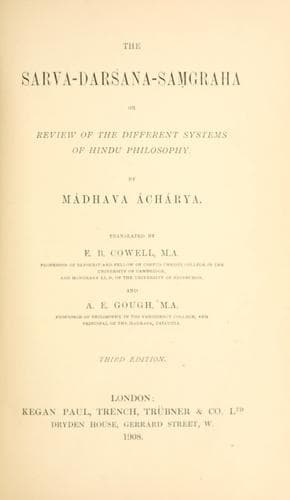
The Sarva-Darsana-Samgraha: Or, Review of the Different Systems of Hindu PhilosophyMadhava
ReligionEastern
The Sarva-Darsana-Samgraha: Or, Review of the Different Systems of Hindu Philosophy
Madhava
Philosophy, Hindu; Philosophy, Indic
assume the existence[330] of an indivisible _sphoṭa_ as a distinct
category, which has the power to manifest the word's meaning. All this
has been established in the discussion (in the Mahábháshya) on "genus"
(_játi_), which aims at proving that the meaning of all words is
ultimately that _summum genus_, _i.e._, that existence whose
characteristic is perfect knowledge of the supreme reality[331]
(Brahman).
"But if all words mean only that supreme existence, then all words
will be synonyms, having all the same meaning; and your grand logical
ingenuity would produce an astonishing result in demonstrating the
uselessness of human language as laboriously using several words to no
purpose at the same time!" Thus it has been said--
"The employment of synonymous terms at the same time is to
be condemned; for they only express their meaning in turn
and not by combination."
"Therefore this opinion of yours is really hardly worth the
trouble of refuting."
All this is only the ruminating of empty ether; for just as the
colourless crystal is affected by different objects which colour it as
blue, red, yellow, &c., so, since the _summum genus_, Brahman, is
variously cognised through its connection with different things, as
severally identified with each, we thus account for the use of the
various conventional words which arise from the different
species,[332] as cow, &c., these being "existence" (the _summum
genus_) as found in the individual cow, &c. To this purport we have
the following authoritative testimony--
"Just as crystal, that colourless substance, when severally
joined with blue, red, or yellow objects, is seen as
possessing that colour."
And so it has been said by Hari, "Existence [pure and simple] being
divided, when found in cows, &c., by reason of its connection with
different subjects, is called this or that species, and on it all
words depend. This they call the meaning of the stem and of the root.
This is existence, this the great soul; and it is this which the
affixed _tva_, _tal_, &c., express" (Páṇini v. 1, 119).
Public-domain text, read in full here on John Shaqi.
Reviews
Reviews
No reviews yet
Be the first to share your thoughts on this work.
Elsewhere in the archive
Join the Discussion
Join the discussion
Sign in to leave a comment or review.
Sign InorCreate an account