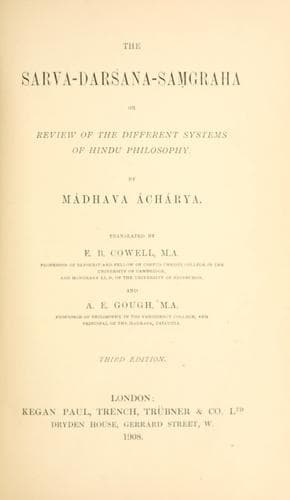
The Sarva-Darsana-Samgraha: Or, Review of the Different Systems of Hindu Philosophy — John Shaqi
The Sarva-Darsana-Samgraha: Or, Review of the Different Systems of Hindu PhilosophyMadhava
ReligionEastern
The Sarva-Darsana-Samgraha: Or, Review of the Different Systems of Hindu Philosophy
Madhava
Philosophy, Hindu; Philosophy, Indic
Perhaps you will say: The entity produces its effect, _together with_
its subsidiaries. Well, then (we reply), let the entity not give up
its subsidiaries, but rather tie them lest they fly with a rope round
their neck, and so produce the effect which it has to produce, and
without forfeiting its own proper nature. Besides (we continue), does
the additament (or supplementation) constituted by the subsidiaries
give rise to another additament or not? In either case the
afore-mentioned objections will come down upon you like a shower of
stones. On the alternative that the additament takes on another
additament, you will be embarrassed by a many-sided regress _in
infinitum_. If when the additament is to be generated another
auxiliary (or additament) be required, there will ensue an endless
series of such additaments: this must be confessed to be one infinite
regress. For example, let a seed be granted to be productive when an
additament is given, consisting of a complement of objects such as
water, wind, and the like, as subsidiaries; otherwise an additament
would be manifested without subsidiaries. Now the seed in taking on
the additament takes it on with the need of (ulterior) subsidiaries;
otherwise, as there would always be subsidiaries, it would follow that
a germ would always be arising from the seed. We shall now have to add
to the seed another supplementation by subsidiaries themselves
requiring an additament. If when this additament is given, the seed be
productive only on condition of subsidiaries as before, there will be
established an infinite regression of additaments to (or
supplementations of) the seed, to be afforded by the subsidiaries.
Again, we ask, does the supplementation required for the production of
the effect produce its effect independently of the seed and the like,
or does it require the seed and the like? On the first alternative (if
the supplementation works independently), it would ensue that the seed
is in no way a cause. On the second (if the supplementation require
the seed), the seed, or whatever it may be that is thus required, must
take on a supplementation or additament, and thus there will be over
and over again an endless series of additaments added to the
additament constituted by the seed; and thus a second infinite
regression is firmly set up.
In like manner the subsidiary which is required will add another
subsidiary to the seed, or whatever it may be that is the subject of
the additions, and thus there will be an endless succession of
additaments added to the additaments to the seed which is supplemented
by the subsidiaries; and so a third infinite regression will add to
your embarrassment.
Public-domain text, read in full here on John Shaqi.
Reviews
Reviews
No reviews yet
Be the first to share your thoughts on this work.
Join the Discussion
Join the discussion
Sign in to leave a comment or review.
Sign InorCreate an account