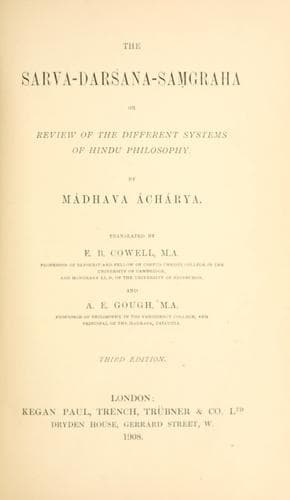
The Sarva-Darsana-Samgraha: Or, Review of the Different Systems of Hindu PhilosophyMadhava
ReligionEastern
The Sarva-Darsana-Samgraha: Or, Review of the Different Systems of Hindu Philosophy
Madhava
Philosophy, Hindu; Philosophy, Indic
Now (or the other grand alternative), let it be granted that a
supplementation identical with the entity (the seed, or whatever it
may be) is taken on. If so, the former entity, that _minus_ the
supplementation, is no more, and a new entity identical with the
supplementation, and designated (in the technology of Buddhism)
_kurvad rúpa_ (or effect-producing object), comes into being: and thus
the tree of my desires (my doctrine of a universal flux) has borne
its fruit.
Practical efficiency, therefore, in the non-momentary is inadmissible.
Nor is practical efficiency possible apart from succession in time;
for such a possibility is redargued by the following dilemma. Is this
(permanent) entity (which you contend for) able to produce all its
effects simultaneously, or does it continue to exist after production
of effects? On the former alternative, it will result that the entity
will produce its effects just as much at one time as at another; on
the second alternative, the expectation of its permanency is as
reasonable as expecting seed eaten by a mouse to germinate.
That to which contrary determinations are attributed is diverse, as
heat and cold; but this thing is determined by contrary attributions.
Such is the argumentation applied to the cloud (to prove that it has
not a permanent but a fluxional existence). Nor is the middle term
disallowable, for possession and privation of power and impotence are
allowed in regard to the permanent (which you assert) at different
times. The concomitance and non-concomitance already described (viz.,
That which can at any time do anything does not fail to do that at
that time, and What at any time does not do anything, that at that
time is unable to do it) are affirmed (by us) to prove the existence
of such power. The negative rule is: What at any time is unable to
produce anything, that at that time does not produce it, as a piece of
stone, for example, does not produce a germ; and this entity (the
seed, or whatever it may be), while exerting a present practical
efficiency, is incapable of past and future practical efficiencies.
The contradiction violating this rule is: What at any time does
anything, that at that time is able to do that thing, as a complement
of causes is able to produce its effect; and this (permanent) entity
exerts at time past and time future the practical efficiencies proper
to those times.
Public-domain text, read in full here on John Shaqi.
Reviews
Reviews
No reviews yet
Be the first to share your thoughts on this work.
Join the Discussion
Join the discussion
Sign in to leave a comment or review.
Sign InorCreate an account