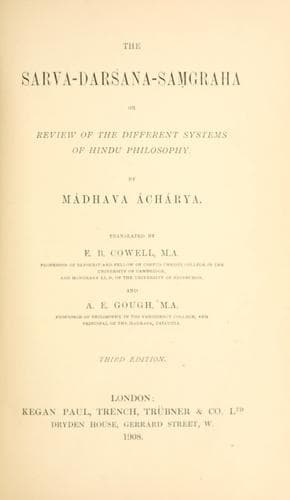
The Sarva-Darsana-Samgraha: Or, Review of the Different Systems of Hindu PhilosophyMadhava
ReligionEastern
The Sarva-Darsana-Samgraha: Or, Review of the Different Systems of Hindu Philosophy
Madhava
Philosophy, Hindu; Philosophy, Indic
"But how can we accept the doctrine of illusory emanation [thus held
by the grammarians, following the guidance of the _púrva_ and _uttara_
Mímáṃsá schools], when the system of development propounded by the
Sáṅkhyas is still alive to oppose it?" Such is their loud vaunt. Now
the Śástra of this school may be concisely said to maintain four
several kinds of existences, viz., that which is evolvent[348] only,
that which is evolute only, that which is both evolute and evolvent,
and that which is neither. (_a._) Of these the first is that which is
only evolvent, called the root-evolvent or the primary; it is not
itself the evolute of anything else. It evolves, hence it is called
the evolvent (_prakṛiti_) since it denotes in itself the equilibrium
of the three qualities, goodness, activity, and darkness. This is
expressed [in the Sáṅkhya Káriká], "the root-evolvent is no evolute."
It is called the root-evolvent, as being both root and evolvent; it is
the root of all the various effects, as the so-called "great one,"
&c., but of it, as the primary, there is no root, as otherwise we
should have a _regressus ad infinitum_. Nor can you reply that such a
_regressus ad infinitum_ is no objection, if, like the continued
series of seed and shoot, it can be proved by the evidence of our
senses,[349]--because here there is no evidence to establish the
hypothesis. (_b._) The "evolutes and evolvents" are the great one,
egoism, and the subtile elements,--thus the Sáṅkhya Káriká (§ 3),
"the seven, the great one, &c., are evolute-evolvents." The seven are
the seven principles, called the great one, &c. Among these the great
principle, called also the intellect,[350] &c., is itself the evolute
of nature and the evolvent of egoism; in the same manner the principle
egoism, called also "self-consciousness" (_abhimána_), is the evolute
of the great one, intellect; but this same principle, as affected by
the quality of darkness, is the evolvent of the five rudiments called
subtile elements; and, as affected by the quality of goodness, it is
the evolvent of the eleven organs, viz., the five organs of
perception, the eye, ear, nose, tongue, and skin; the five organs of
action, the voice, hands, feet, anus, and generative organ; and the
mind, partaking of the character of both; nor can you object that in
our arrangement the third quality, activity, is idle, as it acts as a
cause by producing action in the others. This has been thus declared
by Íśvara Kṛishṇa in his Kárikás[351] (§ 24-27), "Self-consciousness
is egoism. Thence proceeds a twofold creation, the elevenfold set and
the five elemental rudiments. From modified[352] egoism originates the
class of eleven imbued with goodness; from egoism as the source of the
elements originate the rudimentary elements, and these are affected by
darkness; but it is only from egoism as affected by activity that the
one and the other rise. The intellectual organs are the eyes, the
Public-domain text, read in full here on John Shaqi.
Reviews
Reviews
No reviews yet
Be the first to share your thoughts on this work.
Elsewhere in the archive
Join the Discussion
Join the discussion
Sign in to leave a comment or review.
Sign InorCreate an account