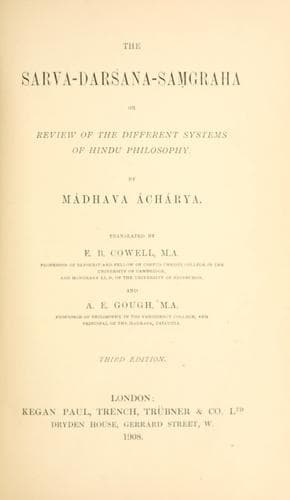
The Sarva-Darsana-Samgraha: Or, Review of the Different Systems of Hindu PhilosophyMadhava
ReligionEastern
The Sarva-Darsana-Samgraha: Or, Review of the Different Systems of Hindu Philosophy
Madhava
Philosophy, Hindu; Philosophy, Indic
ears, the nose, the tongue, and the skin; those of action are the
voice, feet, hands, anus, and organ of generation. In this set is
mind, which has the character of each; it determines, and it is an
organ (like the other ten) from having a common property with
them."[353] All this has been explained at length by the teacher
Váchaspati Miśra in the Sáṅkhya-tattva-kaumudí.
(_c._) The "evolute only" means the five gross elements, ether, &c.,
and the eleven organs, as said in the Káriká, "The evolute consists of
sixteen;" that is, the set of sixteen is evolute only, and not
evolvent. Although it may be said that earth, &c., are the evolvents
of such productions as cows, jars, &c., yet these are not a different
"principle" (_tattva_) from earth, &c., and therefore earth, &c., are
not what we term "evolvents;" as the accepted idea of an evolvent is
that which is the material cause of a separate principle; and in cows,
jars, &c., there is the absence of being any such first principle, in
consequence of their being all alike gross [_i.e._, possessed of
dimensions] and perceptible to the senses. The five gross elements,
ether, &c., are respectively produced from sound, touch, form, taste,
and smell, each subtile element being accompanied by all those which
precede it, and thus the gross elements will have respectively one,
two, three, four, and five qualities.[354] The creation of the organs
has been previously described. This is thus propounded in the Sáṅkhya
Káriká (§ 22)--
"From nature springs the great one, from this egoism, from
this the set of sixteen, and from five among the sixteen
proceed the five gross elements."
(_d._) The soul is neither,--as is said in the Káriká, "The soul is
neither evolvent nor evolute." That is, the soul, being absolute,
eternal, and subject to no development, is itself neither the evolvent
nor the evolute of aught beside. Three kinds of proof are accepted as
establishing these twenty-five principles; and thus the Káriká (§ 4).
"Perception, inference, and the testimony of worthy persons are
acknowledged to be the threefold proof, for they comprise every mode
of demonstration. It is from proof that there results belief of that
which is to be proven."
Here a fourfold discussion arises as to the true nature of cause and
effect. The Saugatas[355] maintain that the existent is produced from
the non-existent; the Naiyáyikas, &c., that the (as yet) non-existent
is produced from the existent; the Vedántins, that all effects are an
illusory emanation from the existent and not themselves really
existent; while the Sáṅkhyas hold that the existent is produced from
the existent.
(_a._) Now the first opinion is clearly untenable, since that which is
itself non-existent and unsubstantial can never be a cause any more
than the hare's horn; and, again, the real and unreal can never be
identical.
Public-domain text, read in full here on John Shaqi.
Reviews
Reviews
No reviews yet
Be the first to share your thoughts on this work.
Elsewhere in the archive
Join the Discussion
Join the discussion
Sign in to leave a comment or review.
Sign InorCreate an account