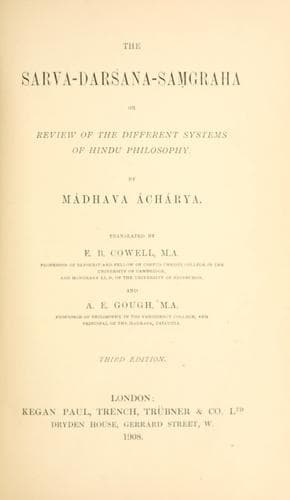
The Sarva-Darsana-Samgraha: Or, Review of the Different Systems of Hindu PhilosophyMadhava
ReligionEastern
The Sarva-Darsana-Samgraha: Or, Review of the Different Systems of Hindu Philosophy
Madhava
Philosophy, Hindu; Philosophy, Indic
(_b._) Nor can the non-existent be produced from the existent; since
it is impossible that that which, previous to the operation of the
originating cause, was as non-existent as a hare's horn should ever be
produced, _i.e._, become connected with existence; for not even the
cleverest man living can make blue yellow.[356] If you say, "But are
not existence and non-existence attributes of the same jar?" this is
incorrect, since we cannot use such an expression as "its quality" in
regard to a non-existent subject, for it would certainly imply that
the subject itself did exist. Hence we conclude that the effect is
existent even previously to the operation of the cause, which only
produces the manifestation of this already existent thing, just like
the manifestation of the oil in sesame seed by pressing, or of the
milk in cows by milking. Again, there is no example whatever to prove
the production of a thing previously non-existent.
Moreover, the cause must produce its effect as being either connected
with it or not connected; in the former alternative the effect's
existence is settled by the rule that connection can only be between
two existent things; in the latter, any and every effect might arise
from any and every cause, as there is nothing to determine the action
of an unconnected thing. This has been thus put by the Sáṅkhya
teacher:--"From the supposed non-existence of the effect, it can have
no connection with causes which always accompany existence; and to him
who holds the production of a non-connected thing there arises an
utter want of determinateness." If you rejoin that "the cause, though
not connected with its effect, can yet produce it, where it has a
capacity of so doing, and this capacity of producing is to be inferred
from seeing the effect actually produced," still this cannot be
allowed, since in such a case as "there is a capacity for producing
oil in sesame seeds," you cannot determine, while the oil is
non-existent, that there is this capacity in the sesame seeds,
whichever alternative you may accept as to their being connected or
not with the oil [since our before-mentioned dilemma will equally
apply here].
Public-domain text, read in full here on John Shaqi.
Reviews
Reviews
No reviews yet
Be the first to share your thoughts on this work.
Elsewhere in the archive
Join the Discussion
Join the discussion
Sign in to leave a comment or review.
Sign InorCreate an account