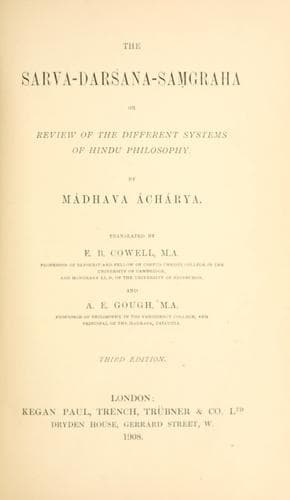
The Sarva-Darsana-Samgraha: Or, Review of the Different Systems of Hindu PhilosophyMadhava
ReligionEastern
The Sarva-Darsana-Samgraha: Or, Review of the Different Systems of Hindu Philosophy
Madhava
Philosophy, Hindu; Philosophy, Indic
From our tenet that the cause and effect are identical, it follows
that the effect does not exist distinct from the cause; thus the cloth
is not something distinct from the threads, as it abides in the latter
[as its material cause]; but where this identity is not found, there
we do not find the relation of cause and effect; thus a horse and a
cow are distinct from each other [for one is not produced from the
other, and therefore their qualities are not the same]; but the cloth
is an acknowledged effect, and therefore not anything different from
its cause.[357] If you object that, if this were true, the separate
threads ought to fulfil the office of clothing, we reply, that the
office of clothing is fulfilled by the threads manifesting the nature
of cloth when they are placed in a particular arrangement. As the
limbs of a tortoise when they retire within its shell are concealed,
and, when they come forth, are revealed, so the particular effects,
as cloth, &c., of a cause, as threads, &c., when they come forth and
are revealed, are said to be produced; and when they retire and are
concealed, they are said to be destroyed; but there is no such thing
as the production of the non-existent or the destruction of the
existent. As has been said in the Bhagavad Gítá (ii. 16)--
"There is no existence for the non-existent, nor
non-existence for the existent."
And, in fact, it is by inference from its effects that we establish
the existence of the great evolvent, Nature (_prakṛiti_). This has
been said [in the Káriká, § 9]--
"Effect exists, for what exists not can by no operation of
cause be brought into existence; materials, too, are
selected which are fit for the purpose; everything is not by
every means possible; what is capable does that to which it
is competent; and like is produced from like."[358]
Public-domain text, read in full here on John Shaqi.
Reviews
Reviews
No reviews yet
Be the first to share your thoughts on this work.
Elsewhere in the archive
Join the Discussion
Join the discussion
Sign in to leave a comment or review.
Sign InorCreate an account