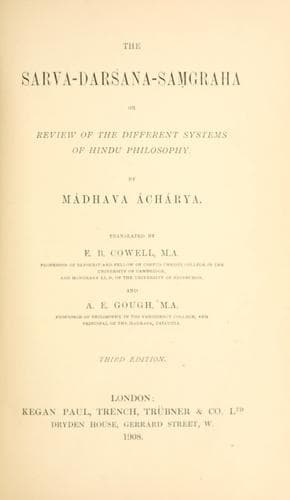
The Sarva-Darsana-Samgraha: Or, Review of the Different Systems of Hindu PhilosophyMadhava
ReligionEastern
The Sarva-Darsana-Samgraha: Or, Review of the Different Systems of Hindu Philosophy
Madhava
Philosophy, Hindu; Philosophy, Indic
Nor can we say [with the Vedántin] that the world is an illusory
emanation from the one existent Brahman, because we have no
contradictory evidence to preclude by its superior validity the _primâ
facie_ belief that the external world is real [as we have in the case
of mistaking a rope for a snake, where a closer inspection will
discover the error]; and again, where the subject and the attributed
nature are so dissimilar as the pure intelligent Brahman and the
unintelligent creation, we can no more allow the supposed attribution
to be possible than in the case of gold and silver [which no one
mistakes for each other]. Hence we conclude that an effect which is
composed of happiness, misery, and stupidity, must imply a cause
similarly composed; and our argument is as follows:--The subject of
the argument, viz., the external world, must have a material cause
composed of happiness, misery, and stupidity, because it is itself
endued therewith; whatever is endued with certain attributes must have
a cause endued with the same,--thus a ring has gold for its material
cause, because it has the attributes of gold; our subject is a similar
case, therefore we may draw a similar conclusion. What we call "being
composed of happiness" in the external world is the quality of
goodness; the "being composed of misery" is the quality of
activity;[359] the "being composed of stupidity" is the quality of
darkness; hence we establish our cause composed of the three qualities
(_i.e._, _prakṛiti_, Nature). And we see that individual objects are
found by experience to have these three qualities; thus Maitra's
happiness is found in his wife Satyavatí, because the quality of
"goodness" in her is manifested towards him; but she is the misery of
her fellow-wives, because the quality of "activity" is manifested
towards them; while she causes indifference to Chaitra who does not
possess her, because towards him the quality of "darkness" is
manifested. So, too, in other cases also; thus a jar, when obtained,
causes us pleasure; when seized by others it causes us pain; but it is
viewed with indifference by one who has no interest in it. Now this
being regarded with no interest is what we mean by "stupidity," since
the word _moha_ is derived from the root _muh_, "to be confused,"
since no direct action of the mind arises towards those objects to
which it is indifferent. Therefore we hold that all things, being
composed of pleasure, pain, and stupidity, must have as their cause
Nature, which consists of the three qualities. And so it is declared
in the Śvetáśvatara Upanishad (iv. 5)--
"The one unborn, for his enjoyment, approaches the one
unborn (Nature) which is red, white, and black, and produces
a manifold and similar offspring; the other unborn abandons
her when once she has been enjoyed."
Public-domain text, read in full here on John Shaqi.
Reviews
Reviews
No reviews yet
Be the first to share your thoughts on this work.
Elsewhere in the archive
Join the Discussion
Join the discussion
Sign in to leave a comment or review.
Sign InorCreate an account