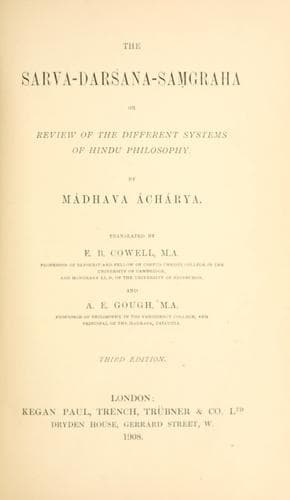
The Sarva-Darsana-Samgraha: Or, Review of the Different Systems of Hindu PhilosophyMadhava
ReligionEastern
The Sarva-Darsana-Samgraha: Or, Review of the Different Systems of Hindu Philosophy
Madhava
Philosophy, Hindu; Philosophy, Indic
Here the words "red," "white," and "black," express the qualities
"activity," "goodness," and "darkness," from their severally
possessing the same attributes of colouring, manifesting, and
concealing.
Here, however, it may be objected, "But will not your unintelligent
Nature, without the superintendence of something intelligent, fail to
produce these effects, intellect, &c.? therefore there must be some
intelligent superintendent; and hence we must assume an all-seeing,
supreme Lord." We reply that this does not follow, since even
unintelligent Nature will act under the force of an impulse; and
experience shows us that an unintelligent thing, without any
intelligent superintendent, does act for the good of the soul, just as
the unintelligent milk acts for the growth of the calf, or just as the
unintelligent rain acts for the welfare of living creatures; and so
unintelligent Nature will act for the liberation of the soul. As it
has been said in the Káriká (§ 57)--
"As the unintelligent milk acts for the nourishment of the
calf, so Nature acts for the liberation of soul."
But as for the doctrine of "a Supreme Being who acts from compassion,"
which has been proclaimed by beat of drum by the advocates of his
existence, this has well-nigh passed away out of hearing, since the
hypothesis fails to meet either of the two alternatives. For does he
act thus _before_ or _after_ creation? If you say "before," we reply
that as pain cannot arise in the absence of bodies, &c., there will be
no need, as long as there is no creation, for his desire to free
living beings from pain [which is the main characteristic of
compassion]; and if you adopt the second alternative, you will be
reasoning in a circle, as on the one hand you will hold that God
created the world through compassion [as this is His motive in acting
at all], and on the other hand[360] that He compassionated after He
had created. Therefore we hold that the development of unintelligent
Nature [even without any intelligent superintendent]--in the order of
the series intellect, self-consciousness, &c.,--is caused by the union
of Nature and Soul, and the moving impulse is the good of Soul. Just
as there takes place a movement in the iron in the proximity of the
unmoved magnet, so there takes place a movement in Nature in the
proximity of the unmoved Soul; and this union of Nature and Soul is
caused by mutual dependence, like the union of the lame man and the
blind man. Nature, as the thing to be experienced, depends on Soul the
experiencer; and Soul looks to final bliss, as it seeks to throw off
the three kinds of pain, which, though really apart from it, have
fallen upon it by its coming under the shadow of intellect through not
recognising its own distinction therefrom.[361] This final bliss [or
absolute isolation] is produced by the discrimination of Nature and
Soul, nor is this end possible without it; therefore Soul depends on
Nature for its final bliss.
Public-domain text, read in full here on John Shaqi.
Reviews
Reviews
No reviews yet
Be the first to share your thoughts on this work.
Elsewhere in the archive
Join the Discussion
Join the discussion
Sign in to leave a comment or review.
Sign InorCreate an account