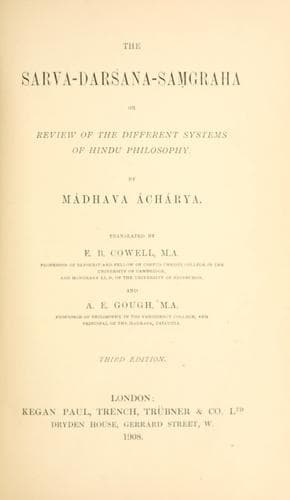
The Sarva-Darsana-Samgraha: Or, Review of the Different Systems of Hindu PhilosophyMadhava
ReligionEastern
The Sarva-Darsana-Samgraha: Or, Review of the Different Systems of Hindu Philosophy
Madhava
Philosophy, Hindu; Philosophy, Indic
Just as a lame man and a blind man,[362]
travelling along with a caravan, by some accident having become
separated from their companions, wandered slowly about in great
dismay, till by good luck they met each other, and then the lame man
mounted on the blind man's back, and the blind man, following the path
indicated by the lame man, reached his desired goal, as did the lame
man also, mounted on the other's shoulders; so, too, creation is
effected by Nature and the soul, which are likewise mutually
dependent. This has been said in the Káriká (§ 21)--
"For the soul's contemplation of Nature and for its final
separation the union of both takes place, as of the lame man
and the blind man. By that union a creation is formed."
"Well, I grant that Nature's activity may take place for the good of
the soul, but how do you account for its ceasing to act?" I reply,
that as a wilful woman whose faults have once been seen by her husband
does not return to him, or as an actress, having performed her part,
retires from the stage, so too does Nature desist. Thus it is said in
the Káriká (§ 59)--
"As an actress, having exhibited herself to the spectators,
desists from the dance, so does Nature desist, having
manifested herself to Soul."
For this end has the doctrine of those who follow Kapila, the founder
of the atheistic Sáṅkhya School, been propounded.
E. B. C.
FOOTNOTES:
[Footnote 348: I borrow this term from Dr. Hall.]
[Footnote 349: Compare Kusumáñjali, i. 4.]
[Footnote 350: One great defect in the Sáṅkhya nomenclature is the
ambiguity between the terms for intellect (_buddhí_) and those for
mind (_manas_). Mádhava here applies to the former the term
_antaḥkaraṇa_ or "internal organ," the proper term for the latter. I
have ventured to alter it in the translation.]
[Footnote 351: It is singular that this is Mádhava's principal Sáṅkhya
authority, and not the Sáṅkhya Sútras.]
[Footnote 352: _Vaikṛita_ is here a technical term meaning that
goodness predominates over darkness and activity. On this Káriká,
comp. Dr. Hall's preface to the Sáṅkhya-sára, pp. 30-35.]
[Footnote 353: As produced, like them, from modified egoism. The
reading _saṃkalpavikalpátmakam_ must be corrected by the Sáṅkhya
Káriká.]
[Footnote 354: Cf. Colebrooke Essays, vol. i. p. 256. The _tanmátras_
will reproduce themselves as the respective qualities of the gross
elements.]
[Footnote 355: A name of the Buddhists.]
[Footnote 356: _I.e._, the nature of a thing (_Svabháva_) cannot be
altered--a man cannot be made a cow, nor a woman a man.]
[Footnote 357: I take _arthántaram_ here as simply _bhinnam_ (cf.
Táránátha Tarkaváchaspati's note, _Tattva Kaumudí_, p. 47).]
[Footnote 358: Colebrooke's translation.]
[Footnote 359: Or "passion," _rajas_.]
Public-domain text, read in full here on John Shaqi.
Reviews
Reviews
No reviews yet
Be the first to share your thoughts on this work.
Elsewhere in the archive
Join the Discussion
Join the discussion
Sign in to leave a comment or review.
Sign InorCreate an account