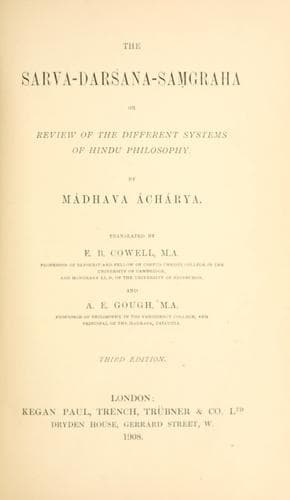
The Sarva-Darsana-Samgraha: Or, Review of the Different Systems of Hindu PhilosophyMadhava
ReligionEastern
The Sarva-Darsana-Samgraha: Or, Review of the Different Systems of Hindu Philosophy
Madhava
Philosophy, Hindu; Philosophy, Indic
[Footnote 360: In other words--on the one hand the existing misery of
beings induced God to create a world in order to relieve their misery,
and on the other hand it was the existence of a created world which
caused their misery at all.]
[Footnote 361: Bondage, &c., reside in the intellect, and are only
_reflected_ upon soul through its proximity (cf.
_Sáṅkhyapravachanabháshya_, i. 58).]
[Footnote 362: This apologue is a widely spread piece of folk-lore. It
is found in the Babylonian Talmud, _Sanhedrim_, fol. 91, _b_, and in
the Gesta Romanorum.]
CHAPTER XV.
THE PATANJALI-DARSÁNA.
We now set forth the doctrine of that school which professes the
opinions of such Munis as Patañjali and others, who originated the
system of the Theistic Sáṅkhya philosophy. This school follows the
so-called Yoga Śástra promulgated by Patañjali, and consisting of four
chapters, which also bears the name of the "Sáṅkhya Pravachana," or
detailed explanation of the Sáṅkhya.[363] In the first chapter thereof
the venerable Patañjali, having in the opening aphorism, "Now is the
exposition of Concentration" (_yoga_), avowed his commencement of the
Yoga Śástra, proceeds in the second aphorism to give a definition of
his subject, "Concentration is the hindering of the modifications of
the thinking principle," and then he expounds at length the nature of
Meditation (_samádhi_). In the second chapter, in the series of
aphorisms commencing, "The practical part of Concentration is
mortification, muttering, and resignation to the Supreme," he expounds
the practical part of _yoga_ proper to him whose mind is not yet
thoroughly abstracted (iii. 9), viz., the five external subservients
or means, "forbearance," and the rest. In the third chapter, in the
series commencing "Attention is the fastening [of the mind] on some
spot," he expounds the three internal subservients--attention,
contemplation, and meditation, collectively called by the name
"subjugation" (_saṃyama_), and also the various superhuman powers
which are their subordinate fruit. In the fourth chapter, in the
series commencing, "Perfections spring from birth, plants, spells,
mortification, and meditation," he expounds the highest end,
Emancipation, together with a detailed account of the five so-called
"perfections" (_siddhis_). This school accepts the old twenty-five
principles [of the Sáṅkhya], "Nature," &c.; only adding the Supreme
Being as the twenty-sixth--a Soul untouched by affliction, action,
fruit, or stock of desert, who of His own will assumed a body in order
to create, and originated all secular or Vaidic traditions,[364] and
is gracious towards those living beings who are burned in the charcoal
of mundane existence.
Public-domain text, read in full here on John Shaqi.
Reviews
Reviews
No reviews yet
Be the first to share your thoughts on this work.
Elsewhere in the archive
Join the Discussion
Join the discussion
Sign in to leave a comment or review.
Sign InorCreate an account