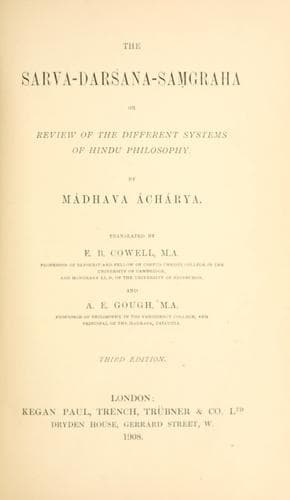
The Sarva-Darsana-Samgraha: Or, Review of the Different Systems of Hindu PhilosophyMadhava
ReligionEastern
The Sarva-Darsana-Samgraha: Or, Review of the Different Systems of Hindu Philosophy
Madhava
Philosophy, Hindu; Philosophy, Indic
The words of the first aphorism, "Now is the exposition of
concentration," establish the four preliminaries which lead to the
intelligent reader's carrying the doctrine into practice, viz., the
object-matter, the end proposed, the connection [between the treatise
and the object], and the person properly qualified to study it. The
word "now" (_atha_) is accepted as having here an inceptive meaning,
[as intimating that a distinct topic is now commenced]. "But," it may
be objected, "there are several possible significations of this word
_atha_; why, then, should you show an unwarranted partiality for this
particular 'inceptive' meaning? The great Canon for nouns and their
gender [the Amara Kosha Dictionary] gives many such meanings. '_Atha_
is used in the sense of an auspicious particle,--after,--now
(inceptive),--what? (interrogatively),--and all (comprehensively).'
Now we willingly surrender such senses as interrogation or
comprehensiveness; but since there are four senses certainly
suitable, _i.e._, 'after,' 'an auspicious particle,' 'reference to a
previous topic,' and 'the inceptive now,' there is no reason for
singling out the _last_." This objection, however, will not stand, for
it cannot bear the following alternative. If you maintain the sense of
"after," then do you hold that it implies following after anything
whatever, or only after some definite cause as comprehended under the
general definition of causation,[367] _i.e._, "previous existence
[relatively to the effect]"? It cannot be the former, for, in
accordance with the proverb that "No one stands for a single moment
inactive," everybody must always do everything after previously doing
something else; and since this is at once understood without any
direct mention at all, there could be no use in employing the particle
_atha_ to convey this meaning. Nor can it be the latter alternative;
because, although we fully grant that the practice of concentration
does in point of fact follow after previous tranquillity, &c., yet
these are rather the necessary preliminaries to the work of
exposition, and consequently cannot have that avowed predominance
[which the presumed _cause_ should have]. "But why should we not hold
that the word _atha_ implies that this very exposition is avowedly the
predominant object, and does follow after previous tranquillity of
mind, &c.?" We reply, that the aphorism uses the term "exposition"
(_anuśásana_), and this word, etymologically analysed, implies that by
which the _yoga_ is explained, accompanied with definitions,
divisions, and detailed means and results; and there is no rule that
such an exposition must follow previous tranquillity of mind, &c., the
rule rather being that, as far as the teacher is concerned, it must
follow a profound knowledge of the truth and a desire to impart it to
others; for it is rather the student's desire to know and his derived
knowledge, which should have quiet of mind, &c., as their precursors,
Public-domain text, read in full here on John Shaqi.
Reviews
Reviews
No reviews yet
Be the first to share your thoughts on this work.
Elsewhere in the archive
Join the Discussion
Join the discussion
Sign in to leave a comment or review.
Sign InorCreate an account