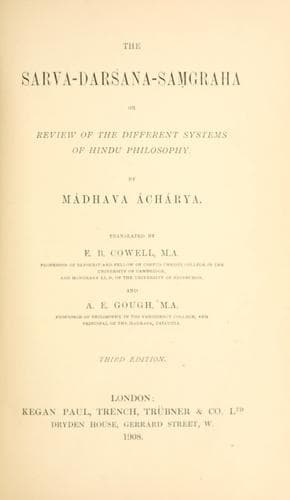
The Sarva-Darsana-Samgraha: Or, Review of the Different Systems of Hindu PhilosophyMadhava
ReligionEastern
The Sarva-Darsana-Samgraha: Or, Review of the Different Systems of Hindu Philosophy
Madhava
Philosophy, Hindu; Philosophy, Indic
in accordance with the words of Śruti: "Therefore having become
tranquil, self-subdued, loftily indifferent, patient, full of faith
and intent, let him see the soul in the soul."[368] Nor can the word
_atha_ imply the necessary precedence, in the teacher, of a profound
knowledge of the truth and a desire to impart it to others; because,
even granting that both these are present, they need not to be
mentioned thus prominently, as they are powerless in themselves to
produce the necessary intelligence and effort in the student. Still
[however we may settle these points] the question arises, Is the
exposition of the _yoga_ ascertained to be a cause of final beatitude
or not? If it is, then it is still a desirable object, even if certain
presupposed conditions should be absent; and if it is not, then it
must be undesirable, whatever conditions may be present.[369] But it
is clear that the exposition in question _is_ such a cause, since we
have such a passage of the Śruti as that [in the Kaṭha Upanishad, ii.
12]: "By the acquirement of _yoga_ or intense concentration on the
Supreme Soul, the wise man having meditated leaves behind joy and
sorrow;" and again, such a passage of the Smṛiti as that [in the
Bhagavad Gítá, ii. 53]: "The intellect unwavering in contemplation
will then attain _yoga_." Hence we conclude that it is untenable to
interpret _atha_ as implying that the exposition must follow "after" a
previous inquiry on the part of the student, or "after" a previous
course of ascetic training and use of elixirs, &c. [to render the body
strong].
But in the case of the Vedánta Sútras, which open with the aphorism,
"Now, therefore, there is the wish to know Brahman," Śaṅkara Áchárya
has declared that the inceptive meaning of _atha_ must be left out of
the question, as the wish to know Brahman is not to be undertaken [at
will]; and therefore it must be there interpreted to mean "after,"
_i.e._, that this desire must follow a previous course of
tranquillity, &c., as laid down by the well-known rule which enjoins
the practice of tranquillity, self-control, indifference, endurance,
contemplation, and faith, the object being to communicate the teaching
to a proper student as distinguished by the possession of the four
so-called "means."[370]
Public-domain text, read in full here on John Shaqi.
Reviews
Reviews
No reviews yet
Be the first to share your thoughts on this work.
Elsewhere in the archive
Join the Discussion
Join the discussion
Sign in to leave a comment or review.
Sign InorCreate an account