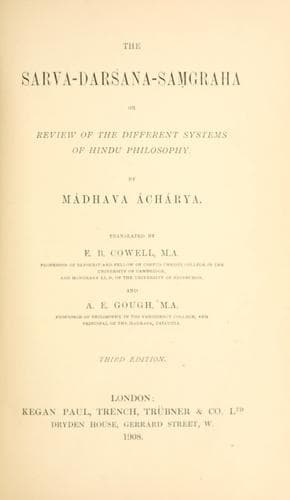
The Sarva-Darsana-Samgraha: Or, Review of the Different Systems of Hindu PhilosophyMadhava
ReligionEastern
The Sarva-Darsana-Samgraha: Or, Review of the Different Systems of Hindu Philosophy
Madhava
Philosophy, Hindu; Philosophy, Indic
"Well, then, let us grant that _atha_ cannot mean 'after;' but why
should it not be simply an auspicious particle?" But this it cannot
be, from the absence of any connection between the context and such
auspicious meaning. Auspiciousness implies the obtaining of an
unimpeached and desired good, and what is desired is so desired as
being the attainment of pleasure or the avoidance of pain; but this
auspiciousness cannot belong to the exposition of _yoga_, since it is
in itself neither pleasure nor the cessation of pain.[371] Therefore
it cannot be at all established that the meaning of the aphorism is
that "the exposition of the _yoga_ is auspicious;" for auspiciousness
cannot be either the primary meaning of _atha_ or its secondary
meaning by metonymy, since it is its very sound which is in itself
auspicious [without any reference to the meaning], like that of a
drum. "But why not say that just as an implied meaning may enter into
the direct meaning of a sentence, so an effect [like this of
auspiciousness] may also be included, since both are equally
unexpressed so far as the actual words are concerned?"[372] We reply,
that in the meaning of a sentence the connection must be between the
meaning of one word and that of another; otherwise we should be guilty
of breaking the seal which the rule of the grammarians has set, that
"verbal expectancy[373] can be fulfilled by _words_ alone."
"But ought not a prayer for an auspicious commencement to be put at
the beginning of a Śástra, in order to lay the hosts of obstacles that
would hinder the completion of the work which the author desires to
begin, and also to observe the immemorial practice of the good, since
it has been said by the wise, 'Those śástras become widely famous
which have auspicious commencements, auspicious middles, and
auspicious endings, and their students have long lives and are
invincible in disputation'?[374] Now the word _atha_ implies
'auspiciousness,' since there is a Smṛiti which says,
"'The word _Om_ and the word _atha_,--these two in the
ancient time,
"'Cleaving the throat of Brahman, came forth; therefore they
are both auspicious.'
Public-domain text, read in full here on John Shaqi.
Reviews
Reviews
No reviews yet
Be the first to share your thoughts on this work.
Elsewhere in the archive
Join the Discussion
Join the discussion
Sign in to leave a comment or review.
Sign InorCreate an account