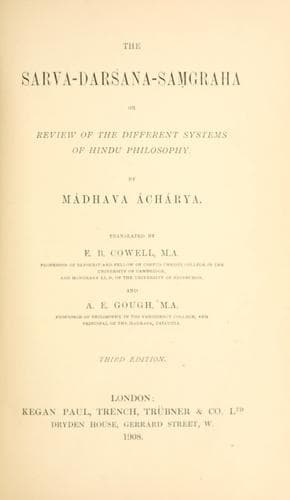
The Sarva-Darsana-Samgraha: Or, Review of the Different Systems of Hindu PhilosophyMadhava
ReligionEastern
The Sarva-Darsana-Samgraha: Or, Review of the Different Systems of Hindu Philosophy
Madhava
Philosophy, Hindu; Philosophy, Indic
"Therefore let the word _atha_ stand here as signifying
'auspiciousness,' like the word '_vṛiddhi_' used by Páṇini in his
opening sútra '_vṛiddhir ád aich_.'"[375] This view, however, is
untenable; since the very word _atha_, when heard, has an auspicious
influence, even though it be employed to convey some other special
signification, just as the hearing the sound of lutes, flutes, &c. [is
auspicious for one starting on a journey]. If you still object, "How
can the particle _atha_ have any other effect, if it is specially used
here to produce the idea that the meaning of the sentence is that a
new topic is commenced?" we reply that it certainly _can_ have such
other additional effect, just as we see that jars of water brought for
some other purpose are auspicious omens at the commencement of a
journey.[376] Nor does this contradict the smṛiti, since the smṛiti
will still hold good, as the words "they are both auspicious" mean
only that they produce an auspicious effect.
Nor can the particle _atha_ have here the meaning of "reference to a
previous topic," since the previously mentioned faults will all equally
apply here, as this meaning really involves that of "after" [which we have
already discussed and rejected]. And again, in such discussions as this,
as to whether this particular _atha_ means "the inceptive now" or "after,"
if another topic had been previously suggested, then "reference thereto"
would be a possible meaning; but in the present case [where no other topic
has been previously suggested] it is not a possible meaning. Therefore, by
exhaustion, the commentator finally adopts, for the _atha_ of the sútra,
the remaining meaning of "the inceptive now." So, when it is said [in the
Táṇḍya Bráhmaṇa, xvi. 8, 1; xvi. 10, 1], "Now this is the Jyotis," "Now
this is the Viśvajyotis,"[377] the particle _atha_ is accepted as
signifying the commencement of the description of a particular sacrifice,
just as the _atha_ in the commencement of the Mahábháshya, "now comes the
exposition of words," signifies the commencement of the Institutes of
Grammar. This has been declared by Vyása in his Commentary on the Yoga
Aphorisms, "the _atha_ in this opening aphorism indicates a commencement;"
and Váchaspati has similarly explained it in his gloss; therefore it may
be considered as settled that the _atha_ here indicates a commencement and
also signifies auspiciousness. Therefore, accepting the view that this
_atha_ implies a commencement, let the student be left in peace to strive
after a successful understanding of the śástra through the attainment of
the _yoga_, which is its proposed subject, by means of the teacher's
explanation of its entire purport. But here some one may say, "Does not
the smṛiti of Yájñavalkya say, 'Hiraṇyagarbha is the promulgator of the
Yoga, and no other ancient sage?' how then is Patañjali the teacher
thereof?" We reply that it was for this reason that the venerable
Public-domain text, read in full here on John Shaqi.
Reviews
Reviews
No reviews yet
Be the first to share your thoughts on this work.
Elsewhere in the archive
Join the Discussion
Join the discussion
Sign in to leave a comment or review.
Sign InorCreate an account