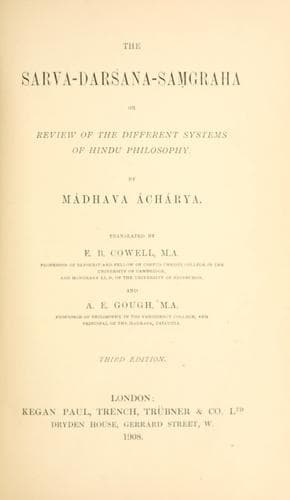
The Sarva-Darsana-Samgraha: Or, Review of the Different Systems of Hindu PhilosophyMadhava
ReligionEastern
The Sarva-Darsana-Samgraha: Or, Review of the Different Systems of Hindu Philosophy
Madhava
Philosophy, Hindu; Philosophy, Indic
Patañjali,[378] that ocean of compassion, considering how difficult it was
to grasp all the different forms of Yoga scattered up and down in the
Puráṇas, &c., and wishing to collect together their essence, commenced his
_anuśásana_,--the preposition _anu_ implying that it was a teaching which
followed a primary revelation and was not itself the immediate origin of
the system.
Since this _atha_ in the aphorism signifies "commencement," the full
meaning of the sentence comes out as follows: "be it known that the
institute for the exposition of the _yoga_ is now commenced." In this
institute the "object-matter," as being that which is produced by it,
is _yoga_ [or the "concentration of the mind"], with its means and its
fruit; the producing this is its inferior "end;" supreme absorption
(_kaivalya_) is the highest "end" of the _yoga_ when it is produced.
The "connection" between the institute and _yoga_ is that of the
producer and the thing to be produced; the "connection" between _yoga_
and supreme absorption is that of the means and the end; and this is
well known from Śruti and Smṛiti, as I have before shown. And it is
established by the general context that those who aim at liberation
are the duly qualified persons to hear this institute. Nor need any
one be alarmed lest a similar course should be adopted with the
opening aphorism of the Vedánta sútras, "Now, therefore, there is a
wish to know Brahman;" and lest here, too, we should seek to
establish by the general context that all persons who aim at
liberation are duly qualified students of the Vedánta. For the word
_atha_, as there used, signifies "succession" [or "after"]; and it is
a settled point that the doctrine can only be transmitted through a
regular channel to duly qualified students, and consequently the
question cannot arise as to whether any other meaning is suggested by
the context. Hence it has been said, "When Śruti comes [as the
determining authority] 'the subject-matter' and the rest have no
place."[379] The full meaning of this is as follows: Where a thing is
not apprehended from the Veda itself, there the "subject-matter" and
the rest can establish the true meaning, not otherwise; but wherever
we can attain the meaning by a direct text, there the other modes of
interpretation are irrelevant. For when a thing is declared by a text
of the Veda which makes its meaning obvious at once, the
"subject-matter" and the rest either establish a contrary conclusion
or one not contrary. Now, in the former case, the authority which
would establish this contrary conclusion is [by the very nature of
"_śruti_"] already precluded from having any force; and in the latter
it is useless. This is all declared in Jaimini's aphorism [iii. 3,
14]; "A definite text, a 'sign,' the 'sentence,' the 'subject-matter,'
the 'relative position,' or 'the title,'--when any of these come into
collision, the later in order is the weaker because its meaning is
more remote"[380] [and therefore less obvious].
Public-domain text, read in full here on John Shaqi.
Reviews
Reviews
No reviews yet
Be the first to share your thoughts on this work.
Elsewhere in the archive
Join the Discussion
Join the discussion
Sign in to leave a comment or review.
Sign InorCreate an account