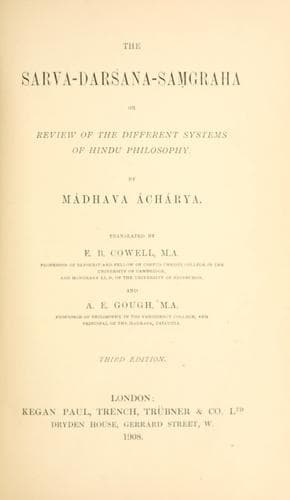
The Sarva-Darsana-Samgraha: Or, Review of the Different Systems of Hindu PhilosophyMadhava
ReligionEastern
The Sarva-Darsana-Samgraha: Or, Review of the Different Systems of Hindu Philosophy
Madhava
Philosophy, Hindu; Philosophy, Indic
It has been thus
summed up--
"A text always precludes the rest; the 'title' is always
precluded by any of the preceding modes;
"But whether any intervening one is precluded, or itself
precludes, depends on circumstances."
Therefore [after all this long discussion] it may be now considered as
settled that, since it has an "object," as well as the other
preliminaries, the study of the Śástra, which teaches the Yoga, is to
be commenced like that of the Vedánta, which discusses the nature of
Brahman. "But," it may be objected, "it is the Yoga which was said to
be the object-matter, since it is this which is to be produced, not
the Śástra." We grant that the Yoga is the principal object, as that
which is to be produced; but since it is produced by the Śástra,
especially directed thereto, this Śástra is the means for its
production, and, as a general rule, the agent's activity is directly
concerned with the means rather than with the end. Just as the
operations of Devadatta the woodcutter, _i.e._, his lifting his arm up
and down, &c., relate rather to the instrument, _i.e._, the axe, than
to the object, _i.e._, the tree, so here the speaker, Patañjali, in
his immediate action of speaking, means the Yoga-Śástra as his primary
object, while he intends the Yoga itself in his ultimate action of
"denotation." In consequence of this distinction, the real meaning is
that the commencing the Yogaśástra is that which primarily claims our
attention; while the "yoga," or the restraint of the modifications of
the mind, is what is to be expounded in this Sáśtra. "But as we read
in the lists of roots that the root _yuj_ is used in the sense of
'joining,' should not the word _yoga_, its derivative, mean
'conjunction,' and not 'restraint'? And indeed this has been said by
Yájñavalkya:[381]--
'The conjunction of the individual and the supreme souls is
called _yoga_.'"
This, however, is untenable, since there is no possibility of any such
action,[382] &c., in either as would produce this conjunction of the two
souls. [Nor, again, is such an explanation needed in order to remove the
opposition of other philosophical schools]; for the notion of the
conjunction of two eternal things is opposed to the doctrines of the
Vaiśeshika and Nyáya schools [and therefore they would still oppose our
theory]. And even if we accepted the explanation in accordance with the
Mímáṃsá [or Vedánta], our Yogaśástra would be rendered nugatory by this
concession [and the very ground cut from under our feet]; because the
identity of the individual and supreme souls being in that school
something already accomplished, it could not be regarded as something to
be produced by our Śástra. And lastly, as it is notorious that roots are
used in many different senses, the root _yuj_ may very well be used here
in the sense of "contemplation."[383] Thus it has been said--
Public-domain text, read in full here on John Shaqi.
Reviews
Reviews
No reviews yet
Be the first to share your thoughts on this work.
Elsewhere in the archive
Join the Discussion
Join the discussion
Sign in to leave a comment or review.
Sign InorCreate an account