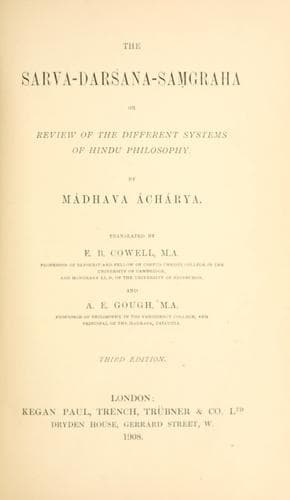
The Sarva-Darsana-Samgraha: Or, Review of the Different Systems of Hindu PhilosophyMadhava
ReligionEastern
The Sarva-Darsana-Samgraha: Or, Review of the Different Systems of Hindu Philosophy
Madhava
Philosophy, Hindu; Philosophy, Indic
"Particles, prepositions, and roots--these three are all
held to be of manifold meaning; instances found in reading
are their evidence."
Therefore some authors expressly give _yuj_ in this sense, and insert
in their lists "_yuj_ in the sense of _samádhi_." Nor does this
contradict Yájñavalkya's declaration, as the word _yoga_, used by him,
may bear this meaning; and he has himself said--
"_Samádhi_ is the state of identity of the individual and
supreme souls; this abiding absolutely in Brahman is the
_samádhi_ of the individual soul."
It has been also said by the venerable Vyása [in his Commentary on the
Yoga-sútras, i. 1], "_Yoga is samádhi_."
An objection however, may be here raised that "the term _samádhi_ is
used by Patañjali [in ii. 29] in the sense of one of the eight
ancillary parts[384] of the eightfold concentration (or _yoga_); and
the whole cannot be thus itself a part as well as a whole, since the
principal and the ancillary must be completely different from each
other, as all their attendant circumstances must be different, just as
we see in the _darśapúrṇamása_ sacrifices and their ancillary rites
the _prayájas_, and therefore _samádhi_ cannot be the meaning of
_yoga_." We however reply that this objection is incorrect; for
although the term _samádhi_ is used for etymological reasons[385] to
express the ancillary part which is really defined [in iii. 3] as "the
contemplation which assumes the form of the object, and is apparently
devoid of any nature of its own;" still the further use of this term
to describe the principal state is justified by the author's wish to
declare the ultimate oneness of the two states [as the inferior
ultimately merges into the superior]. Nor can you hold that etymology
alone can decide where a word can be used; because if so, as the word
_go_, "a bull," is derived by all grammarians from the root _gam_, "to
go," we ought never to use the phrase "a standing bull" [as the two
words would be contradictory], and the man Devadatta, when going,
would properly be called _go_, "a bull;" and, moreover, the Sútra, i.
2, distinctly gives us a definite justification for employing the word
in this sense when it declares that "concentration (_yoga_) is the
suppression of the modifications of the thinking principle." [The
second or principal sense of _samádhi_ will therefore be quite
distinct from the first or inferior.]
Public-domain text, read in full here on John Shaqi.
Reviews
Reviews
No reviews yet
Be the first to share your thoughts on this work.
Elsewhere in the archive
Join the Discussion
Join the discussion
Sign in to leave a comment or review.
Sign InorCreate an account