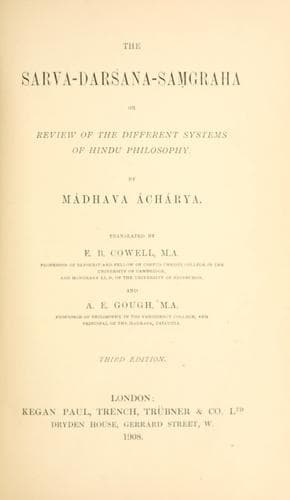
The Sarva-Darsana-Samgraha: Or, Review of the Different Systems of Hindu PhilosophyMadhava
ReligionEastern
The Sarva-Darsana-Samgraha: Or, Review of the Different Systems of Hindu Philosophy
Madhava
Philosophy, Hindu; Philosophy, Indic
"But surely if _yoga_ is held to be the suppression of the
modifications of the thinking principle, then as these modifications
abide in the soul as themselves partaking of the nature of knowledge,
their suppression, or in other words their 'destruction,' would also
abide in the soul, since it is a principle in logic that the
antecedent non-existence and destruction abide in the same subject as
the counter-entity to these negations;[386] and consequently in
accordance with the maxim, 'This newly produced character will affect
the subject in which it resides,' the absolute independence of the
soul itself would be destroyed." This, however, we do not allow;
because we maintain that these various modifications which are to be
hindered,[387] such as "right notion," "misconception," "fancy,"
"sleep," and "memory" (i. 6), are attributes of the internal organ
(_chitta_), since the power of pure intelligence, which is
unchangeable, cannot become the site of this discriminative
perception. Nor can you object that this unchangeable nature of the
intelligent soul[388] has not been proved, since there is an argument
to establish it; for the intelligent soul must be unchangeable from
the fact that it always knows, while that which is not always knowing
is not unchangeable, as the internal organ, &c. And so again, if this
soul were susceptible of change, then, as this change would be
occasional, we could not predicate its always knowing these
modifications. But the true view is, that while the intelligent soul
always remains as the presiding witness, there is another essentially
pure substance[389] which abides always the same; and as it is this
which is affected by any given object, so it is this perceptible
substance which is reflected as a shadow on the soul, and so produces
an impression;[390] and thus Soul itself is preserved in its own
proper independence, and it is maintained to be the always knowing,
and no suspicion of change alights upon it. That object by which the
understanding becomes affected is known; that object by which it is
not affected is not known; for the understanding is called
"susceptible of change," because it resembles the iron, as it is
susceptible of being affected or not by the influence or want of
influence of the object which resembles the magnet,--this influence or
want of influence producing respectively knowledge or the want of
knowledge. "But inasmuch as the understanding and the senses which
spring from egoism are all-pervading, are they not always connected
with all objects, and thus would it not follow that there should be a
knowledge everywhere and always of all things?" We reply that even
although we grant that they are all-pervading, it is only where a
given understanding has certain modifications in a given body, and
certain objects are in a connection with that body, that the knowledge
of these objects only, and none other, is produced to that
understanding; and therefore, as this limitation is absolute, we hold
Public-domain text, read in full here on John Shaqi.
Reviews
Reviews
No reviews yet
Be the first to share your thoughts on this work.
Elsewhere in the archive
Join the Discussion
Join the discussion
Sign in to leave a comment or review.
Sign InorCreate an account