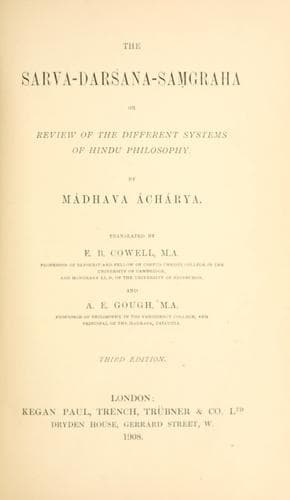
The Sarva-Darsana-Samgraha: Or, Review of the Different Systems of Hindu PhilosophyMadhava
ReligionEastern
The Sarva-Darsana-Samgraha: Or, Review of the Different Systems of Hindu Philosophy
Madhava
Philosophy, Hindu; Philosophy, Indic
that objects are just like magnets, and affect the understanding just
as these do iron,--coming in contact with it through the channels of
the senses. Therefore, the "modifications" belong to the
understanding, not to the soul; and so says the Śruti, "Desire,
volition, doubt, faith, want of faith, firmness, want of
firmness,--all this is only the mind." Moreover, the sage Pañchaśikha
declared the unchangeable nature of the intelligent soul, "The power
that enjoys is unchangeable;" and so Patañjali also (iv. 18), "The
modifications of the understanding are always known,--this arises from
the unchangeableness of the Ruling Soul." The following is the
argument drawn out formally to establish the changeableness of the
understanding. The understanding is susceptible of change because its
various objects are now known and now not known, just like the organ
of hearing and the other organs of sense. Now, this change is
notoriously threefold, _i.e._, a change of "property," of
"aspect,"[391] and of "condition." When the subject, the
understanding, perceives the colour "blue," &c., there is a change of
"property" just as when the substance "gold" becomes a bracelet, a
diadem, or an armlet; there is a change of "aspect" when the property
becomes present, past, or future; and there is a change of "condition"
when there is a manifestation or non-manifestation[392] of the
perception, as of blue, &c.; or, in the case of gold, the [relative]
newness or oldness [at two different moments] would be its change of
condition. These three kinds of change must be traced out by the
reader for himself in different other cases. And thus we conclude that
there is nothing inconsistent in our thesis that, since "right notion"
and the other modifications are attributes of the understanding, their
"suppression" will also have its site in the same organ.
Public-domain text, read in full here on John Shaqi.
Reviews
Reviews
No reviews yet
Be the first to share your thoughts on this work.
Elsewhere in the archive
Join the Discussion
Join the discussion
Sign in to leave a comment or review.
Sign InorCreate an account