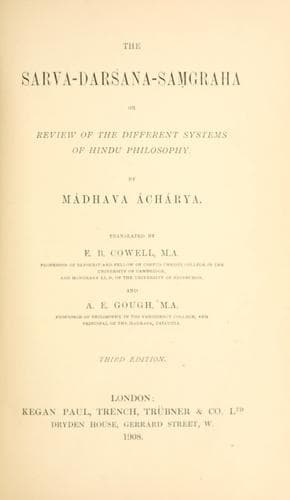
The Sarva-Darsana-Samgraha: Or, Review of the Different Systems of Hindu PhilosophyMadhava
ReligionEastern
The Sarva-Darsana-Samgraha: Or, Review of the Different Systems of Hindu Philosophy
Madhava
Philosophy, Hindu; Philosophy, Indic
[Our opponent now urges a fresh and long objection to what we have
said above.] "But if we accept your definition that '_yoga_ is the
suppression of the modifications of the _chitta_,' this will apply
also to 'sound sleep,' since there too we may find the suppression [or
suspension] of the modifications found in _kshipta_, _vikshipta_,
_múḍha_,[393] &c.; but this would be wrong, because it is impossible
for the 'afflictions' to be abolished so long as those states called
_kshipta_, &c., remain at all, and because they only hinder the
attainment of the _summum bonum_. Let us examine this more closely.
For the understanding is called _kshipta_, 'restless,' when it is
restless [with an excess of the quality _rajas_], as being tossed
about amidst various objects which engage it. It is called _múḍha_,
'blinded,' when it is possessed by the modification 'sleep' and is
sunk in a sea of darkness [owing to an excess of the quality _tamas_].
It is called _vikshipta_, 'unrestless,' when it is different from the
first state[394] [as filled with the quality _sattva_]." We must here,
however, note a distinction; for, in accordance with the line of the
Bhagavad Gítá (vi. 34), 'The mind, O Kṛishṇa, is fickle, turbulent,
violent, and obstinate,' the mind, though naturally restless, may
occasionally become fixed by the transient fixedness of its objects;
but restlessness is innate to it, or it is produced in it by sickness,
&c., or other consequences of former actions; as it is said [in the
Yoga Sútras, i. 30], 'Sickness, languor, doubt, carelessness,
laziness, addiction to objects, erroneous perception, failure to
attain some stage, and instability,--these distractions of the mind
are called "obstacles".' Here 'sickness' means fever, &c., caused by
the want of equilibrium between the three humours; 'languor' is the
mind's want of activity; 'doubt' is a sort of notion which embraces
two opposite alternatives; 'carelessness' is a negligence of using the
means for producing meditation; 'laziness' is a want of exertion from
heaviness of body, speech, or mind; 'addiction to objects' is an
attachment to objects of sense; 'erroneous perception' is a mistaken
notion of one thing for another; 'failure to attain some stage' is the
failing for some reason or other to arrive at the state of abstract
meditation; 'instability' is the mind's failure to continue there,
even when the state of abstract meditation has been reached. Therefore
we maintain that the suppression of the mind's modifications cannot be
laid down as the definition of _yoga_.
Public-domain text, read in full here on John Shaqi.
Reviews
Reviews
No reviews yet
Be the first to share your thoughts on this work.
Elsewhere in the archive
Join the Discussion
Join the discussion
Sign in to leave a comment or review.
Sign InorCreate an account