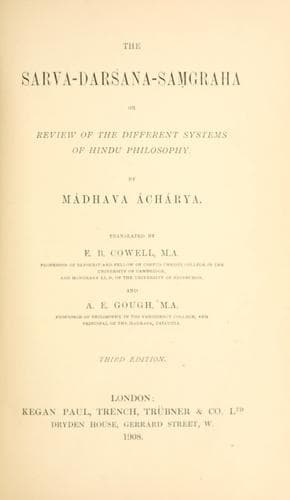
The Sarva-Darsana-Samgraha: Or, Review of the Different Systems of Hindu PhilosophyMadhava
ReligionEastern
The Sarva-Darsana-Samgraha: Or, Review of the Different Systems of Hindu Philosophy
Madhava
Philosophy, Hindu; Philosophy, Indic
We reply, that even although we allow that, so far as regards the
three conditions of the mind called _kshipta_, _múḍha_, and
_vikshipta_, which [as being connected with the three qualities] are
all to be avoided as faulty states, the suppression of the
modifications in these conditions is itself something to be avoided
[and so cannot be called _yoga_], this does not apply to the other two
conditions called _ekágra_ and _niruddha_, which are to be pursued and
attained; and therefore the suppression of the modifications in these
two praiseworthy conditions is rightly to be considered as _yoga_. Now
by _ekágra_ we mean that state when the mind, entirely filled with the
_sattva_ quality, is devoted to the one object of meditation; and by
_niruddha_ we mean that state when all its developments are stopped,
and only their latent impressions [or potentialities] remain.
Now this _samádhi_, "meditation" [in the highest sense], is twofold: "that
in which there is distinct recognition" (_saṃprajñáta_), and "that in
which distinct recognition is lost" (_asaṃprajñáta_) [Yoga S., i. 17,
18].[395] The former is defined as that meditation where the thought is
intent on its own object, and all the "modifications," such as "right
notion," &c., so far as they depend on external things, are suppressed,
or, according to the etymology of the term, it is where the intellect[396]
is thoroughly recognised (_samyak prajñáyate_) as distinct from Nature. It
has a fourfold division, as _savitarka_, _savichára_, _sánanda_, and
_sásmita_. Now this "meditation" is a kind of "pondering" (_bhávaná_),
which is the taking into the mind again and again, to the exclusion of all
other objects, that which is to be pondered. And that which is thus to be
pondered is of two kinds, being either Íśwara or the twenty-five
principles. And these principles also are of two kinds--senseless and not
senseless. Twenty-four, including nature, intellect, egoism, &c., are
senseless; that which is not senseless is Soul. Now among these objects
which are to be pondered, when, having taken as the object the gross
elements, as earth, &c., pondering is pursued in the form of an
investigation as to which is antecedent and which consequent,[397] or in
the form of a union of the word, its meaning, and the idea which is to be
produced [cf. i. 42]; then the meditation is called "argumentative"
(_savitarka_). When, having taken as its object something subtile, as the
five subtile elements and the internal organ, pondering is pursued in
relation to space, time, &c., then the meditation is called "deliberative"
(_savichára_). When the mind, commingled with some "passion" and
"darkness," is pondered, then the meditation is called "beatific"
(_sánanda_), because "goodness" is then predominant, which consists in the
manifestation of joy.[398] When pondering is pursued, having as its object
the pure element of "goodness," unaffected by even a little of "passion"
Public-domain text, read in full here on John Shaqi.
Reviews
Reviews
No reviews yet
Be the first to share your thoughts on this work.
Elsewhere in the archive
Join the Discussion
Join the discussion
Sign in to leave a comment or review.
Sign InorCreate an account