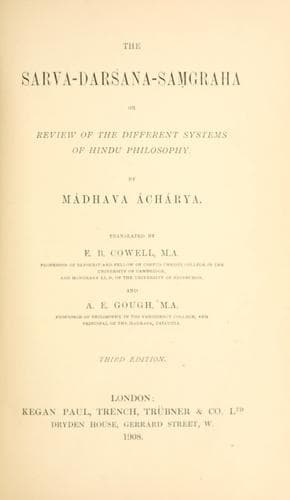
The Sarva-Darsana-Samgraha: Or, Review of the Different Systems of Hindu PhilosophyMadhava
ReligionEastern
The Sarva-Darsana-Samgraha: Or, Review of the Different Systems of Hindu Philosophy
Madhava
Philosophy, Hindu; Philosophy, Indic
or "darkness," then that meditation is called "egoistical" (_sásmita_),
because here personal existence[399] only remains, since the intellectual
faculty becomes now predominant, and the quality of "goodness" has become
quite subordinate [as a mere stepping-stone to higher things].
But the "meditation, where distinct recognition is lost," consists in
the suppression of all "modifications" whatever.
"But" [it may be asked] "was not 'concentration' defined as the
suppression of all the modifications? How, then, can the 'meditation
where there is distinct recognition' be included in it at all, since
we still find active in it that modification of the mind, with the
quality of goodness predominant, which views the soul and the quality
of goodness as distinct from each other?" This, however, is untenable,
because we maintain that concentration is the suppression of the
"modifications" of the thinking power, as especially stopping the
operation of the "afflictions," the "actions," the "fructifications,"
and the "stock of deserts."[400]
The "afflictions" (_kleśa_) are well known as five, viz., ignorance,
egoism, desire, aversion, and tenacity of mundane existence. But here
a question is at once raised, In what sense is the word _avidyá_,
"ignorance," used here? Is it to be considered as an _avyayíbháva_
compound, where the former portion is predominant, as in the word
"above-board"?[401] or is it a _tatpurusha_ [or _karmadháraya_]
compound, where the latter portion is predominant, as in the word
"town-clerk"? or is it a _bahuvríhi_ compound, where both portions are
dependent on something external to the compound, as "blue-eyed"? It
cannot be the first; for if the former portion of the compound were
predominant, then we should have the negation the emphatic part in
_avidyá_ (_i.e._, it would be an instance of what is called the
express negation, or _prasajya-pratishedha_);[402] and consequently,
as _avidyá_ would be thus emphatically a negation, it would be unable
to produce positive results, as the "afflictions," &c., and the very
form of the word should not be feminine, but neuter. It cannot be the
second; for any knowledge, whatever thing's absence it may be
characterised by (_a_ + _vidyá_), opposes the "afflictions," &c., and
cannot therefore be their source. Nor can it be the third; for
then,--in accordance with the words of the author of the Vṛitti,[403]
"there is a _bahuvríhi_ compound which is formed with some word
meaning 'existence' used after 'not,' with the optional elision of
this subsequent word"[404]--we must explain this supposed _bahuvríhi_
compound _avidyá_ as follows: "That _buddhi_ is to be characterised as
_avidyá_ (_sc._ an adjective), of which there is not a _vidyá_
existing." But this explanation is untenable; for such an _avidyá_
could not become the source of the "afflictions;"[405] and yet, on the
other hand, it ought to be their source,[406] even though it were
Public-domain text, read in full here on John Shaqi.
Reviews
Reviews
No reviews yet
Be the first to share your thoughts on this work.
Elsewhere in the archive
Join the Discussion
Join the discussion
Sign in to leave a comment or review.
Sign InorCreate an account