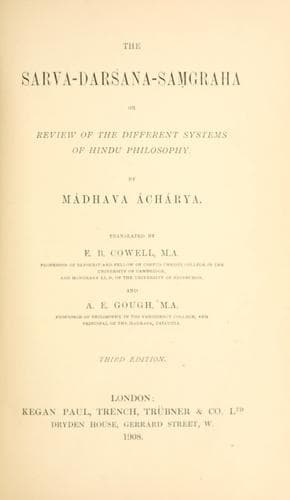
The Sarva-Darsana-Samgraha: Or, Review of the Different Systems of Hindu PhilosophyMadhava
ReligionEastern
The Sarva-Darsana-Samgraha: Or, Review of the Different Systems of Hindu Philosophy
Madhava
Philosophy, Hindu; Philosophy, Indic
associated with the suppression of all the "modifications,"[407] and
were also accompanied by that discriminative knowledge of the soul and
the quality of goodness [which is found in the _sásmita_ meditation].
Now it is said [in the Yoga Sútras, ii. 4], "Ignorance is the field
[or place of origin, _i.e._, source] of the others, whether they be
dormant, extenuated, intercepted, or simple." They are said to be
"dormant" when they are not manifested for want of something to wake
them up; they are called "extenuated" when, through one's meditating
on something that is opposed to them, they are rendered inert; they
are called "intercepted" when they are overpowered by some other
strong "affliction;" they are called "simple" when they produce their
several effects in the direct vicinity of what co-operates with them.
This has been expressed by Váchaspati Miśra, in his Gloss on Vyása's
Commentary, in the following memorial stanza:--
"The dormant 'afflictions' are found in those souls which
are absorbed in the _tattvas_ [_i.e._, not embodied, but
existing in an interval of mundane destruction]; the
'extenuated'[408] are found in _yogins_; but the
'intercepted' and the 'simple' in those who are in contact
with worldly objects."
"No one proposes the fourth solution of the compound _avidyá_ as a
_dvandva_ compound,[409] where both portions are equally predominant,
because we cannot recognise here two equally independent subjects.
Therefore under any one of these three admissible alternatives[410]
the common notion of ignorance as being the cause of the 'afflictions'
would be overthrown."
[We do not, however, concede this objector's view], because we may
have recourse to the other kind of negation called _paryudása_ [where
the affirmative part is emphatic], and maintain that _avidyá_ means a
contradictory [or _wrong_] kind of knowledge, the reverse of _vidyá_;
and so it has been accepted by ancient writers. Thus it has been
said--
"The particle implying 'negation' does not signify 'absence'
[or 'non-existence'] when connected with a noun or a root;
thus the words _abráhmaṇa_ and _adharma_ respectively
signify, 'what is other than a Bráhman' and 'what is
contrary to justice.'"
And again--
"We are to learn all the uses of words from the custom of
the ancient writers; therefore a word must not be wrested
from the use in which it has been already employed."
Public-domain text, read in full here on John Shaqi.
Reviews
Reviews
No reviews yet
Be the first to share your thoughts on this work.
Elsewhere in the archive
Join the Discussion
Join the discussion
Sign in to leave a comment or review.
Sign InorCreate an account