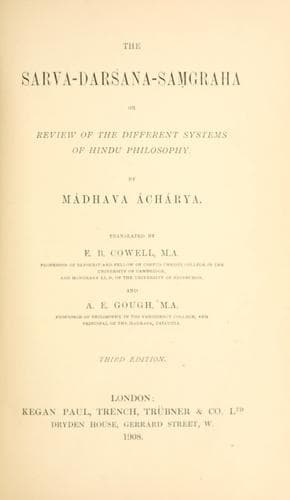
The Sarva-Darsana-Samgraha: Or, Review of the Different Systems of Hindu PhilosophyMadhava
ReligionEastern
The Sarva-Darsana-Samgraha: Or, Review of the Different Systems of Hindu Philosophy
Madhava
Philosophy, Hindu; Philosophy, Indic
As I was at that time the Oriental Secretary of the Bengal Asiatic
Society, I was naturally attracted to the book; and I subsequently
read it with my friend Paṇḍit Maheśachandra Nyáyaratna, the present
Principal of the Sanskrit College at Calcutta. I always hoped to
translate it into English; but I was continually prevented by other
engagements while I remained in India. Soon after my return to
England, I tried to carry out my intention; but I found that several
chapters, to which I had not paid the same attention as to the rest,
were too difficult to be translated in England, where I could no
longer enjoy the advantage of reference to my old friends the Paṇḍits
of the Sanskrit College. In despair I laid my translation aside for
years, until I happened to learn that my friend, Mr. A. E. Gough, at
that time a Professor in the Sanskrit College at Benares, was thinking
of translating the book. I at once proposed to him that we should do
it together, and he kindly consented to my proposal; and we
accordingly each undertook certain chapters of the work. He had the
advantage of the help of some of the Paṇḍits of Benares, especially of
Paṇḍit Ráma Miśra, the assistant Professor of Sáṅkhya, who was himself
a Rámánuja; and I trust that, though we have doubtless left some
things unexplained or explained wrongly, we may have been able to
throw light on many of the dark sayings with which the original
abounds. Our translations were originally published at intervals in
the Benares Paṇḍit between 1874 and 1878; but they have been carefully
revised for their present republication.
The work itself is an interesting specimen of Hindu critical ability.
The author successively passes in review the sixteen philosophical
systems current in the fourteenth century in the South of India, and
gives what appeared to him to be their most important tenets, and the
principal arguments by which their followers endeavoured to maintain
them; and he often displays some quaint humour as he throws himself
for the time into the position of their advocate, and holds, as it
were, a temporary brief in behalf of opinions entirely at variance
with his own.[1] We may sometimes differ from him in his judgment of
the relative importance of their doctrines, but it is always
interesting to see the point of view of an acute native critic. In the
course of his sketches he frequently explains at some length obscure
details in the different systems; and I can hardly imagine a better
guide for the European reader who wishes to study any one of these
Darśanas in its native authorities. In one or two cases (as notably in
the Bauddha, and perhaps in the Jaina system) he could only draw his
materials second-hand from the discussions in the works of Brahmanical
controversialists; but in the great majority he quotes directly from
the works of their founders or leading exponents, and he is
continually following in their track even where he does not quote
their exact words.[2]
Public-domain text, read in full here on John Shaqi.
Reviews
Reviews
No reviews yet
Be the first to share your thoughts on this work.
Join the Discussion
Join the discussion
Sign in to leave a comment or review.
Sign InorCreate an account