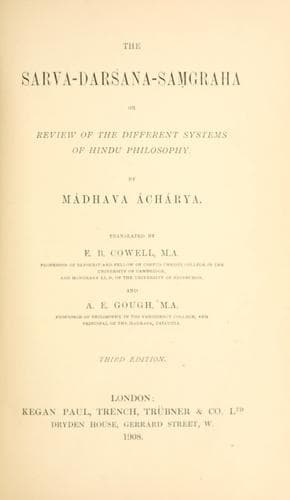
The Sarva-Darsana-Samgraha: Or, Review of the Different Systems of Hindu PhilosophyMadhava
ReligionEastern
The Sarva-Darsana-Samgraha: Or, Review of the Different Systems of Hindu Philosophy
Madhava
Philosophy, Hindu; Philosophy, Indic
The systems are arranged from the Vedánta point of view,--our author
having been elected, in A.D. 1331, the head of the Smárta order in
the Maṭh of Śṛingeri in the Mysore territory, founded by Śaṃkara
Áchárya, the great Vedántist teacher of the eighth century, through
whose efforts the Vedánta became what it is at present--the
acknowledged view of Hindu orthodoxy. The systems form a gradually
ascending scale,--the first, the Chárváka and Bauddha, being the
lowest as the furthest removed from the Vedánta, and the last, the
Sáṅkhya and Yoga, being the highest as approaching most nearly to it.
The sixteen systems here discussed attracted to their study the noblest
minds in India throughout the mediæval period of its history. Hiouen
Thsang says of the schools in his day: "Les écoles philosophiques sont
constamment en lutte, et le bruit de leurs discussions passionnées s'élève
comme les flots de la mer. Les hérétiques des diverses sectes s'attachent
à des maîtres particuliers, et, par des voies différentes, marchent tous
au même but." We can still catch some faint echo of the din as we read the
mediæval literature. Thus, for instance, when King Harsha wanders among
the Vindhya forests, he finds "seated on the rocks and reclining under the
trees Árhata begging monks, Śvetapadas, Mahápáśupatas, Páṇḍarabhikshus,
Bhágavatas, Varṇins, Keśaluñchanas, Lokáyatikas, Kápilas, Káṇádas,
Aupanishadas, Ísvarakárins, Dharmaśástrins, Pauráṇikas, Sáptatantavas,
Śábdas, Páñcharátrikas, &c., all listening to their own accepted tenets
and zealously defending them."[3] Many of these sects will occupy us in
the ensuing pages; many of them also are found in Mádhava's poem on the
controversial triumphs of Śaṃkara Áchárya, and in the spurious prose work
on the same subject, ascribed to Anantánandagiri. Well may some old poet
have put into the mouth of Yudhishṭhira the lines which one so often hears
from the lips of modern paṇḍits--
Vedá vibhinnáḥ smṛitayo vibhinná,
Násau munir yasya mataṃ na bhinnam,
Dharmasya tattvaṃ nihitaṃ guháyáṃ,
Mahájano yena gataḥ sa pantháḥ.[4]
And may we not also say with Clement of Alexandria,
μιᾶς τοίνυν οὔσης τῆς ἀληθείας, τὸ γὰρ ψεῦδος μυρίας
ἐκτροπὰς ἔχει, καθάπερ αἱ βάκχαι τὰ τοῦ Πενθέως διαφορήσασαι
μέλη αἱ τῆς φιλοσοφίας τῆς τε βαρβάρου τῆς τε
Ἑλληνικῆς αἱρέσεις, ἑκάστη ὅπερ ἔλαχεν, ὡς πᾶσαν αὐχεῖ
τὴν ἀλήθειαν, φωτὸς δ', οἶμαι, ἀνατολῇ πάντα φωτίζεται.
E. B. C.
FOOTNOTES:
[Footnote 1: The most remarkable instance of this philosophical
equanimity is that of Váchaspati Miśra, who wrote standard treatises
on each of the six systems except the Vaiśeshika, adopting, of course,
the peculiar point of view of each, and excluding for the time every
alien tenet.]
[Footnote 2: An index of the names of authors and works quoted is
given in Dr. Hall's Bibliographical Catalogue, pp. 162-164, and also
in Professor Aufrecht's Bodleian Catalogue, p. 247.]
[Footnote 3: Śríharsha-charita, p. 204 (Calcutta ed.)]
Public-domain text, read in full here on John Shaqi.
Reviews
Reviews
No reviews yet
Be the first to share your thoughts on this work.
Join the Discussion
Join the discussion
Sign in to leave a comment or review.
Sign InorCreate an account