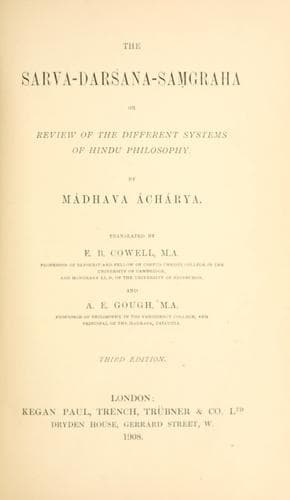
The Sarva-Darsana-Samgraha: Or, Review of the Different Systems of Hindu PhilosophyMadhava
ReligionEastern
The Sarva-Darsana-Samgraha: Or, Review of the Different Systems of Hindu Philosophy
Madhava
Philosophy, Hindu; Philosophy, Indic
"But is it not the mind which is then intent upon the soul and not the
senses, since these are only adapted for external objects, and
therefore have no power for this supposed action? How, therefore,
could they be accommodated to the nature of the mind?" What you say
is quite true; and therefore the author of the aphorisms, having an
eye to their want of power for this, introduced the words "as it
were," to express "resemblance." "Restraint is, as it were, the
accommodation of the senses to the nature of the mind in the absence
of concernment with each one's own object" [ii. 54]. Their absence of
concernment with their several objects for the sake of being
accommodated to the nature of the mind is this "resemblance" which we
mean. Since, when the mind is restrained, the eye, &c., are
restrained, no fresh effort is to be expected from them, and they
follow the mind as bees follow their king. This has been declared in
the Vishṇu-puráṇa [vi. 7, 43, 44]--
"Let the devotee, restraining his organs of sense, which
ever tend to pursue external objects,
"Himself intent on restraint, make them conformable to the
mind;
"By this is effected the entire subjugation of the unsteady
senses;
"If they are not controlled, the _yogin_ will not accomplish
his _yoga_."[454]
"Attention" (_dháraṇá_) is the fixing the mind, by withdrawing it from
all other objects, on some place, whether connected with the internal
self, as the circle of the navel, the lotus of the heart, the top of
the _sushumṇá_ artery, &c., or something external, as Prajápati,
Vásava, Hiraṇyagarbha, &c. This is declared by the aphorism,
"'Attention' is the fixing the mind on a place" [iii. 1]; and so, too,
say the followers of the Puráṇas--
"By regulation of breath having controlled the air, and by
restraint the senses,
"Let him next make the perfect asylum the dwelling-place of
his mind."[455]
The continual flow of thought in this place, resting on the object to
be contemplated, and avoiding all incongruous thoughts, is
"contemplation" (_dhyána_); thus it is said, "A course of uniform
thought there, is 'contemplation'" [iii. 2]. Others also have said--
"A continued succession of thoughts, intent on objects of
that kind and desiring no other,
"This is 'contemplation,'--it is thus effected by the first
six of the ancillary things."
We incidentally, in elucidating something else, discussed the
remaining eighth ancillary thing, "meditation" (_samádhi_, see p.
243). By this practice of the ancillary means of _yoga_, pursued for a
long time with uninterrupted earnestness, the "afflictions" which
hinder meditation are abolished, and through "exercise" and
"dispassion" the devotee attains to the perfections designated by the
names Madhumatí and the rest.
Public-domain text, read in full here on John Shaqi.
Reviews
Reviews
No reviews yet
Be the first to share your thoughts on this work.
Elsewhere in the archive
Join the Discussion
Join the discussion
Sign in to leave a comment or review.
Sign InorCreate an account