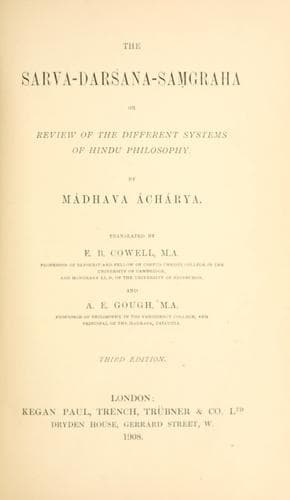
The Sarva-Darsana-Samgraha: Or, Review of the Different Systems of Hindu PhilosophyMadhava
ReligionEastern
The Sarva-Darsana-Samgraha: Or, Review of the Different Systems of Hindu Philosophy
Madhava
Philosophy, Hindu; Philosophy, Indic
"But why do you needlessly frighten us with unknown and monstrous
words from the dialects of Karṇáṭa, Gauḍa,[456] and Láṭa?"[457] We do
not want to frighten you, but rather to gratify you by explaining the
meaning of these strange words; therefore let the reader who is so
needlessly alarmed listen to us with attention.
i. The _Madhumatí_ perfection,--this is the perfection of meditation,
called "the knowledge which holds to the truth," consisting in the
illumination of unsullied purity by means of the contemplation of
"goodness," composed of the manifestation of joy, with every trace of
"passion" or "darkness" abolished by "exercise," "dispassion," &c.
Thus it is said in the aphorisms, "In that case there is the knowledge
which holds to the truth" [i. 48]. It holds "to the truth," _i.e._, to
the real; it is never overshadowed by error. "In that case," _i.e._,
when firmly established, there arises this knowledge to the second
yogin. For the _yogins_ or devotees to the practice of _yoga_ are
well known to be of four kinds, viz.,--
i. The _práthamakalpika_, in whom the light has just entered,[458]
but, as it has been said, "he has not won the light which consists in
the power of knowing another's thoughts, &c.;" 2. The _madhubhúmika_,
who possesses the knowledge which holds to the truth; 3. The
_prajñájyotis_, who has subdued the elements and the senses; 4. The
_atikránta-bhávaníya_, who has attained the highest dispassion.
ii. The _Madhupratíká_ perfections are swiftness like thought, &c.
These are declared to be "swiftness like thought, the being without
organs, and the conquest of nature" [iii. 49]. "Swiftness like
thought" is the attainment by the body of exceeding swiftness of
motion, like thought; "the being without bodily organs"[459] is the
attainment by the senses, irrespective of the body, of powers directed
to objects in any desired place or time; "the conquest of nature" is
the power of controlling all the manifestations of nature. These
perfections appear to the full in the third kind of yogin, from the
subjugation by him of the five senses and their essential
conditions.[460] These perfections are severally sweet, each one by
itself, as even a particle of honey is sweet, and therefore the second
state is called _Madhupratíká_ [_i.e._, that whose parts are sweet].
Public-domain text, read in full here on John Shaqi.
Reviews
Reviews
No reviews yet
Be the first to share your thoughts on this work.
Elsewhere in the archive
Join the Discussion
Join the discussion
Sign in to leave a comment or review.
Sign InorCreate an account