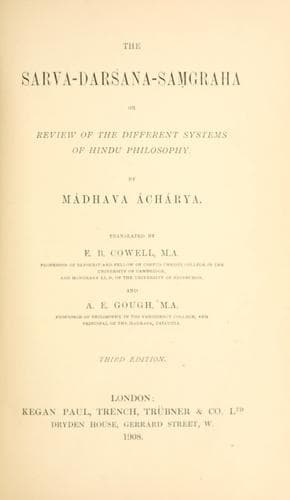
The Sarva-Darsana-Samgraha: Or, Review of the Different Systems of Hindu PhilosophyMadhava
ReligionEastern
The Sarva-Darsana-Samgraha: Or, Review of the Different Systems of Hindu Philosophy
Madhava
Philosophy, Hindu; Philosophy, Indic
iii. The _Viśoká_ perfection consists in the supremacy over all
existences, &c. This is said in the aphorisms, "To him who possesses,
to the exclusion of all other ideas, the discriminative knowledge of
the quality of goodness and the soul, arises omniscience and the
supremacy over all existences" [iii. 50]. The "supremacy over all
existences" is the overcoming like a master all entities, as these are
but the developments of the quality of "goodness" in the mind [the
other qualities of "passion" and "darkness" being already abolished],
and exist only in the form of energy and the objects to be energised
upon.[461] The discriminative knowledge of them, as existing in the
modes "subsided," "emerged," or "not to be named,"[462] is
"omniscience." This is said in the aphorisms [i. 36], "Or a luminous
immediate cognition, free from sorrow[463] [may produce steadiness of
mind]."
iv. The _Saṃskáraśeshatá_ state is also called _asaṃprajñáta_, _i.e._,
"that meditation in which distinct recognition of an object is lost;"
it is that meditation "without a seed" [_i.e._, without any object]
which is able to stop the "afflictions" that produce fruits to be
afterwards experienced in the shape of rank, length of life, and
enjoyment; and this meditation belongs to him who, in the cessation of
all modifications of the internal organ, has reached the highest
"dispassion." "The other kind of meditation [_i.e._, that in which
distinct recognition of an object is lost] is preceded by that
exercise of thought which produces the entire cessation of
modifications; it has nothing left but the latent impressions" [of
thought after the departure of all objects] [_i.e._, _saṃskáraśesha_,
i. 18]. Thus this foremost of men, being utterly passionless towards
everything, finds that the seeds of the "afflictions," like burned
rice-grains, are bereft of the power to germinate, and they are
abolished together with the internal organ. When these are destroyed,
there ensues, through the full maturity of his unclouded
"discriminative knowledge," an absorption of all causes and effects
into the primal _prakṛiti_; and the soul, which is the power of pure
intelligence, abiding in its own real nature, and escaped from all
connection with the phenomenal understanding (_buddhi_), or with
existence, reaches "absolute isolation" (_kaivalya_). Final liberation
is described by Patañjali as two perfections: "Absolute isolation is
the repressive absorption[464] of the 'qualities' which have
consummated the ends of the soul, _i.e._, enjoyment and liberation,
or the abiding of the power of intelligence in its own nature" [iv.
33]. Nor should any one object, "Why, however, should not the
individual be born again even though this should have been attained?"
for that is settled by the well-known principle that "with the
cessation of the cause the effect ceases," and therefore this
objection is utterly irrelevant, as admitting neither inquiry nor
Public-domain text, read in full here on John Shaqi.
Reviews
Reviews
No reviews yet
Be the first to share your thoughts on this work.
Elsewhere in the archive
Join the Discussion
Join the discussion
Sign in to leave a comment or review.
Sign InorCreate an account