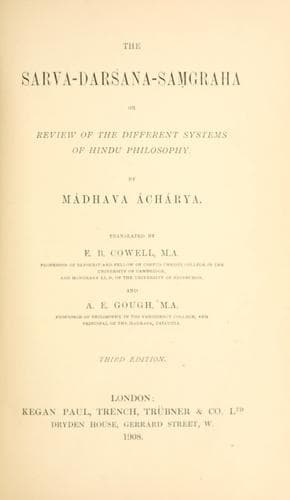
The Sarva-Darsana-Samgraha: Or, Review of the Different Systems of Hindu PhilosophyMadhava
ReligionEastern
The Sarva-Darsana-Samgraha: Or, Review of the Different Systems of Hindu Philosophy
Madhava
Philosophy, Hindu; Philosophy, Indic
decision; for otherwise, if the effect could arise even in the absence
of the cause, we should have blind men finding jewels, and such like
absurdities; and the popular proverb for the impossible would become a
possibility. And so, too, says the Śruti, "A blind man found a jewel;
one without fingers seized it; one without a neck put it on; and a
dumb man praised it."[465]
Thus we see that, like the authoritative treatises on medicine, the
Yoga-śástra consists of four divisions; as those on medicine treat of
disease, its cause, health, and medicine, so the Yoga-śástra also
treats of phenomenal existence, its cause, liberation, and its cause.
This existence of ours, full of pain, is what is to be escaped from;
the connection of nature and the soul is the cause of our having to
experience this existence; the absolute abolition of this connection
is the escape; and right insight is the cause thereof.[466] The same
fourfold division is to be similarly traced as the case may be in
other Śástras also. Thus all has been made clear.
The system of Śaṅkara, which comes next in succession, and which is
the crest-gem of all systems, has been explained by us elsewhere; it
is therefore left untouched here.[467]
E. B. C.
* * * * *
NOTE ON THE YOGA.
There is an interesting description of the Yogins on the Mountain
Raivataka in Mágha (iv. 55):--
"There the votaries of meditation, well skilled in benevolence
(_maitrí_) and those other purifiers of the mind,--having successfully
abolished the 'afflictions' and obtained the 'meditation possessed of
a seed,' and having reached that knowledge which recognises the
essential difference between the quality Goodness and the
Soul,--desire yet further to repress even this ultimate meditation."
It is curious to notice that _maitrí_, which plays such a prominent
part in Buddhism, is counted in the Yoga as only a preliminary
condition from which the votary is to take, as it were, his first
start towards his final goal. It is called a _parikarman_ (=
_prasádhaka_) in Vyása's Comm. i. 33 (cf. iii. 22), whence the term is
borrowed by Mágha. Bhoja expressly says that this purifying process is
an external one, and not an intimate portion of yoga itself; just as
in arithmetic the operations of addition, &c., are valuable, not in
themselves, but as aids in effecting the more important calculations
which arise subsequently. The Yoga seems directly to allude to
Buddhism in this marked depreciation of its cardinal virtue.
* * * * *
NOTE ON P. 237, LAST LINE.
For the word _vyákopa_ in the original here (see also p. 242, l. 3
_infra_), cf. Kusumáñjali, p. 6, l. 7.
FOOTNOTES:
[Footnote 363: On this see Dr. Hall's Pref. to Sáṅkhya Pr. Bhásh., p.
20; S. Sára, p. 11.]
[Footnote 364: _I.e._, he revealed the Veda, and also originated the
meanings of words, as well as instructed the first fathers of mankind
in the arts of life.]
Public-domain text, read in full here on John Shaqi.
Reviews
Reviews
No reviews yet
Be the first to share your thoughts on this work.
Elsewhere in the archive
Join the Discussion
Join the discussion
Sign in to leave a comment or review.
Sign InorCreate an account