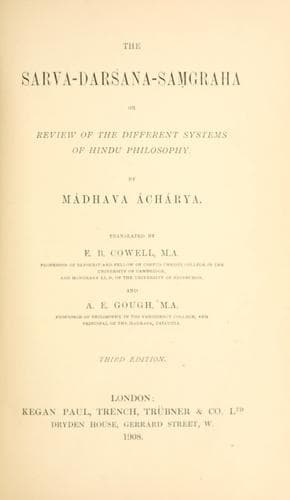
The Sarva-Darsana-Samgraha: Or, Review of the Different Systems of Hindu PhilosophyMadhava
ReligionEastern
The Sarva-Darsana-Samgraha: Or, Review of the Different Systems of Hindu Philosophy
Madhava
Philosophy, Hindu; Philosophy, Indic
[Footnote 365: I read _ye_ for _te_ with Dr. Hall's MS. _Tapya_ means
rather "susceptible of suffering."]
[Footnote 366: This is really Vyása's comm. on Sút., iv. 21.]
[Footnote 367: Cf. _Bháshá-parichchheda_, 15, _a_.]
[Footnote 368: Śatapatha Br., xiv. 7, 2, 28.]
[Footnote 369: I read in the second clause _tadbháve'pi_,
understanding by _tad_ the different conditions which _atha_ is
supposed to assume as being necessarily present.]
[Footnote 370: These are, i., the discrimination of the eternal from
the phenomenal; ii., the rejection of the fruit of actions here or
hereafter; iii., the possession of the six qualities, tranquillity,
&c.; and, iv., the desire for liberation.]
[Footnote 371: It may be _sukha-janaka_, but it is not itself
_sukha_.]
[Footnote 372: Granting that _atha_ does not here mean "auspicious,"
why should not this be the implied meaning, as all allow that the
particle _atha_ does produce an auspicious influence?]
[Footnote 373: _i.e._, a word's incapacity to convey a meaning without
some other word to complete the construction.]
[Footnote 374: This is found with some variations in the Mahábháshya
(p. 7, Kielhorn's ed.)]
[Footnote 375: The commentators hold that the word _vṛiddhiḥ_ is
placed at the beginning of the first sútra, while _guṇaḥ_ in the
second is placed at the end (_ad eṅ guṇaḥ_), in order to ensure an
auspicious opening, _vṛiddhi_ meaning "increase," "prosperity," as
well as "the second strengthening of a vowel."]
[Footnote 376: In the old Bengali poem Chaṇḍí, we have an interesting
list of these omens. The hero Chandraketu, starting on a journey, has
the following good omens: On his right hand a cow, a deer, a Bráhman,
a full-blown lotus; on his left, a jackal and a jar full of water. He
hears on his right hand the sound of fire and a cowherdess calling
"milk" to buyers. He sees a cow with her calf, a woman calling "jaya,"
_dúrvá_ grass, rice, garlands of flowers, diamonds, sapphires, pearls,
corals; and on the left twelve women. He hears drums and cymbals, and
men dancing and singing "Hari." It is, however, all spoiled by seeing
a guana (_godhiká_). The author adds, "This is a bad omen according to
all śástras, and so is a tortoise, a rhinoceros, the tuberous root of
the water-lily, and a hare." Elsewhere, a vulture, a kite, a lizard,
and a woodman carrying wood are called bad omens.]
[Footnote 377: These are the names of two out of the four sacrifices
lasting for one day, in which a thousand cows are given to the
officiating Bráhmans.]
[Footnote 378: He is here called _phaṇipati_, "lord of
snakes,"--Patañjali, the author of the Mahábháshya, being represented
as a snake in mythology.]
[Footnote 379: Cf. Śaṅkara, Vedánta-Sút., iii. 3, 49.]
Public-domain text, read in full here on John Shaqi.
Reviews
Reviews
No reviews yet
Be the first to share your thoughts on this work.
Elsewhere in the archive
Join the Discussion
Join the discussion
Sign in to leave a comment or review.
Sign InorCreate an account